a big thanks

It feels entirely fitting that I’m blogging for Grand Aspirations around Thanksgiving.  Since my involvement with Grand Aspirations and Summer of Solutions began in May, I’ve experienced an amazing transformation in how I think about the world and the opportunities around me that I’m extremely thankful for.  Nope, I haven’t tuned out the facts that we’re already experiencing the effects of climate change, mountains are still being blown up in Appalachia and we’re in the throes of the worst depression since the 1930s.  It’s all in how I’ve started to look at those facts and the systems that create them.

I recently read in an article by two excellent researchers, Julie Graham and Stephen Healy, that captured how I used to think:

“[the economy is] understood as a force outside community and environment that effectively determines their fates.”

“If the practice of conventional economic development is about accommodating the demands of the (global) economy, environmentalism in its various incarnations is about resisting, or compromising with this same external force… …We can either say ‘no’ to economic development entirely or we can accept an unsatisfying compromise between development and environment. “

Building Community Economies: A Post Capitalist Project of Sustainable Development pages 4 and 8

This is a pretty intractable situation.  Economists portray environmentalists as anti-development and elitist, while environmentalists portray economists as, well, the source of all evil.  Enter Martha Pskowski, an environmentalist intent on studying economics.

The past year has taught me that people all around the world are forging ahead regardless of globalization, economic crisis and political stalemate.  And these groups aren’t just addressing the climate and ecological crises we’re facing, they’re redefining their community economies.  Young farmers starting CSAs and subsidizing low-income shares, community bike shops making bike commuting an affordable reality, cooperative housing keeping rent low and foreclosure at bay.  The list goes on.

Students at Hampshire College run an all-volunteer natural food co-op and keep prices cheap!

This is really what Graham and Healy wrote their article to ask:

“What if we could produce a different representation of economy that no longer functions as a force outside community that issues demands?  If a different understanding of economy were to free us from obsessively trying to satisfy (or resist) an external master, what new conceptions of ‘sustainable development’ might emerge?” Page 10-11

These are the same questions Grand Aspirations inspires participants to ask.  The options I see for myself in the economy expand and multiply every day.  And the ways our ecology can be nurtured and celebrated seem more and more accessible.  Not to say I could quit school and walk into my new job tomorrow.  But that’s the point.  We’re building the jobs of the future.   And I couldn’t be more thankful.
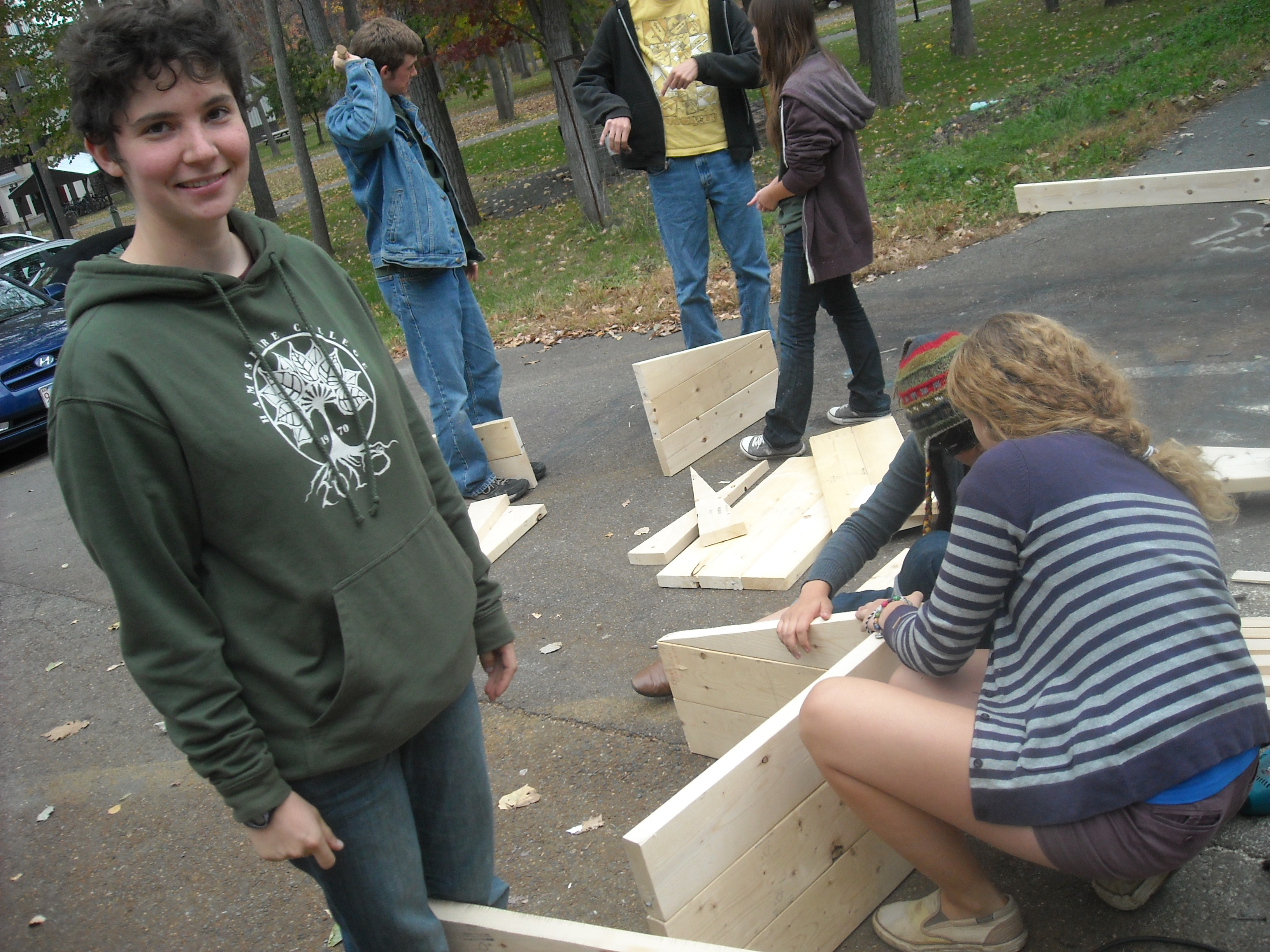
Students build cold frames to extend the growing season in a community garden.
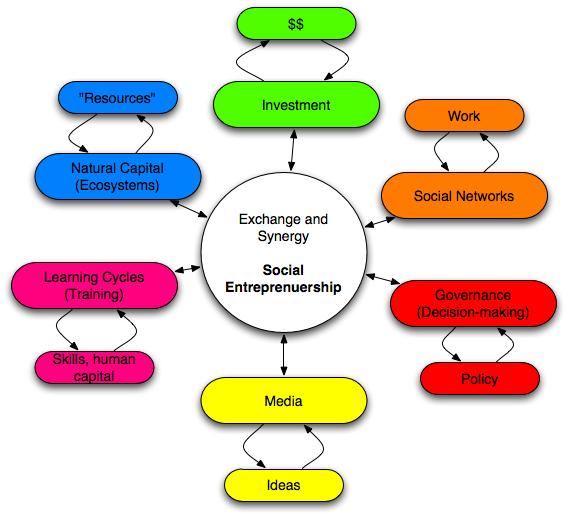


Money, Money, Money

Growing up, my family and I were very involved in our community theatre, which was probably my first close encounter with the term “non-profit.” As a kid, I wondered why selling tickets was so important if they weren’t looking for a profit. Of course, I soon learned that non-profit is far from meaning non-revenue-generating. Even if the prerogative of your organization isn’t to make a profit, you need money to operate and to further your vision. This fall, I’ve been thinking about this a lot as I’ve been working on the national resources team for Grand Aspirations. Specifically, I’ve been thinking about the sources from which we get (or seek to get) funding.

Throughout November, we’re involved in an online voting competition to get a $50K grant from the Pepsi Refresh Project. While the organization has determined this is funding that is well worth seeking and I agree, it provides an opportunity to think about how non-profits are funded, and how wealth is created. In an environmental geography class this semester, there was a discussion on sustainable development and the notion (partly propagated by the environmental Kuznetz curve ) that wealth is necessary for environmental preservation. I found this problematic as it’s so frequently discussed in terms of wealth created through (the very unsustainable variety of) industrialization and consumption. So we’ll pollute and deplete and then we’ll have the cash to plant some trees?

Obviously, that’s a pretty brief and incomplete version of an extensive and complex issue, but that’s basically the conundrum I’ve been contemplating. Pepsi is an obvious example, since that funding is pretty directly branded. However, I’m sure that many foundations that would give grants to organizations like GA are at least partially funded by corporations with maybe less than desirable labor or environmental practices. I mean, I admittedly haven’t don’t research on this, but I think it’s a distinct possibility.

In the national teams there has been concern raised about getting stuck in grant cycles, and besides the fundamental problem of dependence, I would consider the factors discussed above another concern. It doesn’t bring me down though, it makes me really excited about opportunities we have for social entrepreneurship methods of revenue generating. Social entrepreneurship changes the story about how wealth is created, and can provide a good funding source for non-profits as well. If we’re trying to encourage such changes in our economy and society, shouldn’t we be getting the money to operate from activities that constitute acting out this vision?

That said, I really hope we do win the grant from Pepsi Refresh, so we can jump start a lot of this, and I encourage you to start voting daily if you haven’t already.

[Note:I did totally jack the title from this:] 

Bioneers Inspires

By Jennice Rodriguez
Reno, NV
Posted by Casey Wojtalewicz

A few weeks back I was given the chance to attend environmental/peace conference, Bioneers, for the second time in Marin County California.  The event, if you haven’t experienced it already, is something beyond the power of words could describe.  A festival organized for enriching the mind and activating the activist deep inside the soul each attendee.  It’s a place where some of the most powerful people are united in the same place to talk about their work, the work of others, and the work that we as a society need to start engaging in.

It’s a place where lifelong learners come to be taught and experience all the different ways our mother is trying to get us to listen.  It’s a place where the hungry come to be fed the fruit of exposed dirty treason of the powerful forces in our country, but with as much information that is being shared, it is more enlightening than depressing, more electric than any festival I have ever experienced (besides Burning Man…which could totally be compared to this event, in another blog maybe).

Though it may sound quite terrifying–and it is!–Bioneers is a place where possibilities meet the golden ticket to Willy Wonka’s Chocolate Factory.  Bioneers has been the root of so many ideas I have to make this world, to save this world, our world, a place I want to live in.

I walked away this year with so many contacts, I don’t even know what to do with them all. I made friends that I already know better than people I’ve known for years. One idea that hasn’t stopped flickering in the glass window of my memory shop: I was told to find something I am passionate about, and start from there.

But what am I passionate about?  I love my fruits and veggies, and I want everyone to be able to access only the purest food, sure.  I think green energy is something that our government needs to get in check with and make it happen already, sure.  I think marijuana should be legalized and the production of hemp products will save the land that has become ever so exhausted, sure.  But what am I really passionate about?

I have been overwhelmed with the numbers in which one person can dedicate their power to, and I want to do it all, but I can’t do it alone.  Until I find out what it is that I’m passionate about, I need your help, and she needs ours.

Developing Leadership

A tomato plant viewed from below with the sun in the backround.

Photography by Martha Pskowski.

Since September, I’ve been working on the national Leadership Development Team, planning for training weeks at Summer of Solutions programs around the country. We’ve done a lot since we got started, reviewing and editing old trainings as well as developing new ones. I have been excited to discover that the members of our team are all really motivated to make Grand Aspirations an organization that works against oppression. This past weekend, I turned the anti-oppression workshop that we did during the Twin Cities program in 2010 into a replicable template that other programs can use. As I was reading over the notes my co-facilitator Hannah had sent me, it really brought me back to the experience. I was reminded how powerful of an activity this was. By talking about our own identities and the way that we experienced those identities, we were able to begin a practice of speaking honestly from our own experiences. For me, there was the added value of learning how to facilitate a conversation about deeply felt identities that builds towards trust and openness rather than closing people off from each other.

As I was discussing with Hannah the best way to attribute the work that had gone into creating this workshop, I realized all the different perspectives and experiences that had gone into making this template the way it is now. While we will do our best to capture the people who contributed directly in the sources listed at the top of all Grand Aspirations templates, it got me thinking about all the people who it would be impossible to cite who contributed. Conversations that I have had and articles and blog posts that I’ve read shaped the way I wrote the template, and I’m sure that there is a web of connection and learning back from every person in every organization who worked on this training. As different facilitators give this training in the future, they will bring their own personal experience to the way that they facilitate it.

To me, this diversity of experience and opinion is one of the most important reasons to work towards an anti-oppressive organization. People with homogeneous identities are different people — I am different from my sister, for example, despite our identical class background, race, ethnicity, geographic location, religious upbringing, gender, and parents — but we can’t create solutions for a heterogeneous world based on only our experience. I am excited to work with Leadership Development Team to see how we can recognize and expand diverse leadership in the organization and our programs.

Think-tanking about Solutions

Cross posted with revisions from Minnesota 2020’s Hindsight Blog

I spent my time in the Twin Cities this summer with Summer of Solutions. Since that summer, I’ve been thinking about intersections between the abstract concepts of “the economy” and “the environment” and the communities where these ideas become realities. During my fall semester at Macalester, I’ve been spending time at an internship for Minnesota 2020, a progressive non-partisan public policy think-tank in the Twin Cities, and I have the opportunity to write about moving Minnesota’s economic policy forward.

of  ago, Will Allen from Growing Power Inc (Milwaukee, WI) spoke at Macalester’s campus at a fundraiser dinner for the Women’s Environmental Institute. It was awesome. In the audience I recognized the faces of Cities organizers, activists and entrepreneurs that I had met through Summer of Solutions. Allen’s speech and got me thinking about how permaculture could go statewide and mainstream, so I got to write about it for MN2020:

The turn toward blustery and freezing weather this week signals the end of harvest season here in Minnesota and the beginning of even more Californian, Mexican and South American imports. Meaning that multi-national agriculture corporation owners will benefit from more of our food dollars.

The world’s warmer regions certainly have an advantage when it comes to year-round food production. Large-scale agricultural methods could not support any crop through a Minnesotan winter.  But thanks to innovative and sustainable growing techniques, fresh salad greens grown in Milwaukee and fresh tomatoes grown in southern Minnesota are becoming an affordable option for consumers.

At most grocery stores in Mankato, Rochester and the Twin Cities you can find Bushel Boy tomatoes, grown in Owatonna, Minnesota, on the shelves all winter long. Bushel Boy grows its tomatoes in greenhouses without pesticides or herbicides. Bees pollinate the tomatoes and predator insects eat any pests that appear. Because Bushel Boy’s produce doesn’t travel thousands of miles to get to a grocery store, these local, vine-ripened vegetables have better nutritional value than their artificially ripened counter-parts.

Over in Milwaukee, Growing Power Inc, a non-profit urban farming organization, takes sustainable, job-creating food production a few steps further. Growing Power’s intensive urban farm design combines raising fish, livestock, poultry, and fresh produce with solar panels, compost, and an anerobic digestor that generate enough heat and electricity to power green houses through the winter. At their Milwaukee location, a two acre urban farm employs 35 full-time staff; generates revenue by selling compost, meat and produce; and offers classes and workshops for folks in the neighborhood. Growing Power unites sustainable food production, economic development and social justice.

Bushel Boy and Growing Power set examples of what year-round farming in Minnesota could look like. Both use efficient, common-sense methods that support the local economy and produce healthy and more cost-competitive food year round. There is still a long way to go before we can make these  systems a widespread reality. The first step is to recognize that economic development takes many forms, including through local, innovative and sustainable agriculture.”

I will continue to think about ways to communicate what I learned and experienced during SOS this semester…Check out MN2020’s blog or website!