In Highland Park, A Region Raises a Hoop Hous

http://univercities.wordpress.com/2011/07/06/in-highland-park-a-region-raises-a-hoop-house/

written by Joel Batterman

A barn-raising in the heart of Detroit? That’s certainly what it felt like as activists from across the region gathered in Highland Park on Sunday, June 26, to construct a 2000-square-foot hoop house from plastic sheeting and metal tubes. This solar-powered greenhouse can grow food year-round—even in Michigan winters. Armed with the right equipment, it doesn’t take more than a day to construct one. As UniverCities Energy Data Intern Jordan Eizenga and other Suburbs Alliance staff found, it does take a number of willing hands.

Jordan Eizenga is framed by the house’s metal structure.

Jordan (not to be confused with Energy Policy Intern Jordan G.) found lending his hands easy enough. He moved to Ferndale this summer to be near the Suburbs Alliance main office, and biked the few short miles along Woodward Avenue from Ferndale to help build the house. The site was behind the Green Economy Leadership Training (GELT) house near Woodward and McNichols. A branch of a national youth network organizing for solutions to global climate change, GELT seeks to give young people a holistic understanding of the transition to a sustainable, community-scaled economy through neighborhood projects like the hoop house.

Things heat up in the hoop house’s interior.

By late morning, most of the metal hoops that formed the hoop house’s structure were already in place, and the lot was a hive of activity. Builders included master hoop-house mechanic Jeff McCabe, co-founder of Ann Arbor’s SELMA Café, Margaret Lewis, publisher of the Highland Park-based Legacy News, and scores of others from the block, the neighborhood and the greater region. Now that’s metropolitan cooperation in action! While at rest, the group traded farming tips and enjoyed impromptu rapping from the youngest attendees.

The plastic sheeting has been hauled into place.

“Billow it!” As the sun sank lower, the team gathered on either side of the curving metal frame to push and pull the plastic walls of the house into place, sending ripples through the giant sheets to carry them over the top. Slowly, under the careful hands of Jordan and two dozen others, the double sheets slid down to meet the wooden frame near the ground. What had been empty space open to the elements at dawn became a warmer interior where plants will grow come winter.

Collective celebration with the help of a timpani.

There’s much more to be done before the hoop house produces its first crops. For Jordan and the other six Suburbs Alliance staff on hand, though, the day was an inspiring confirmation that people from all over the area can come together to build a healthier, greener and tastier future. Working cooperatively, the group built in one day what a single person couldn’t have constructed alone. Metro Detroit needs to bring that lesson to a regional scale: we’re stronger together.

Renewable Energy > Nuclear!

In the aftermath of the Japanese disaster, politicians around the globe have been debating the necessity of including nuclear as part of the transition to a clean energy future. Unlike other leaders who have placed moratoriums on the licensing of new plants, American politicians have largely stuck by nuclear–a consensus that perhaps was aided by storm of nuclear lobbyists on Capitol Hill.

But, as of last month, the U.S. renewable energy industry has reached an important milestone: domestic production is now greater than that of nuclear power.

This milestone has been reached by important leaps in the renewable sector, particularly from solar-generated electricity which increased by 104.8 percent in the first three months of 2011 compared to the first quarter of 2010.

While renewable energy still has a long way to go before it catches up to fossil fuels, the recent jump in production could play a major role in a nuclear debate that has often denounced the ability of renewable energy to provide stable and sufficient power. While most people agree that nuclear carries inherent meltdown risks and poses the serious challenge of radioactive waste storage, support for nuclear power was at an all-time high among the American public before the disaster in Japan.

Last February, the World Wildlife Fund released a provocative energy report  of an future world run entirely by renewable energy, set in 2050. The report was quickly followed by two papers from professors at Stanford and UC Davis envisioning a similar future but one solely reliant on already existing renewables, mainly solar and wind.

The tide is clearly changing with more academics, politicians and activists agreeing that renewable energy is the way of the future. Whereas nuclear power plants go for at least $10 billion a pop, Summer of Solutions Oakland is partnering with Solar Mosaic to build community solar projects with investments as small as $100. I know where I’m putting my money…

Cross-posted at  the Solar Mosaic blog http://solarmosaic.com/blog/renewable-energy-nuclear


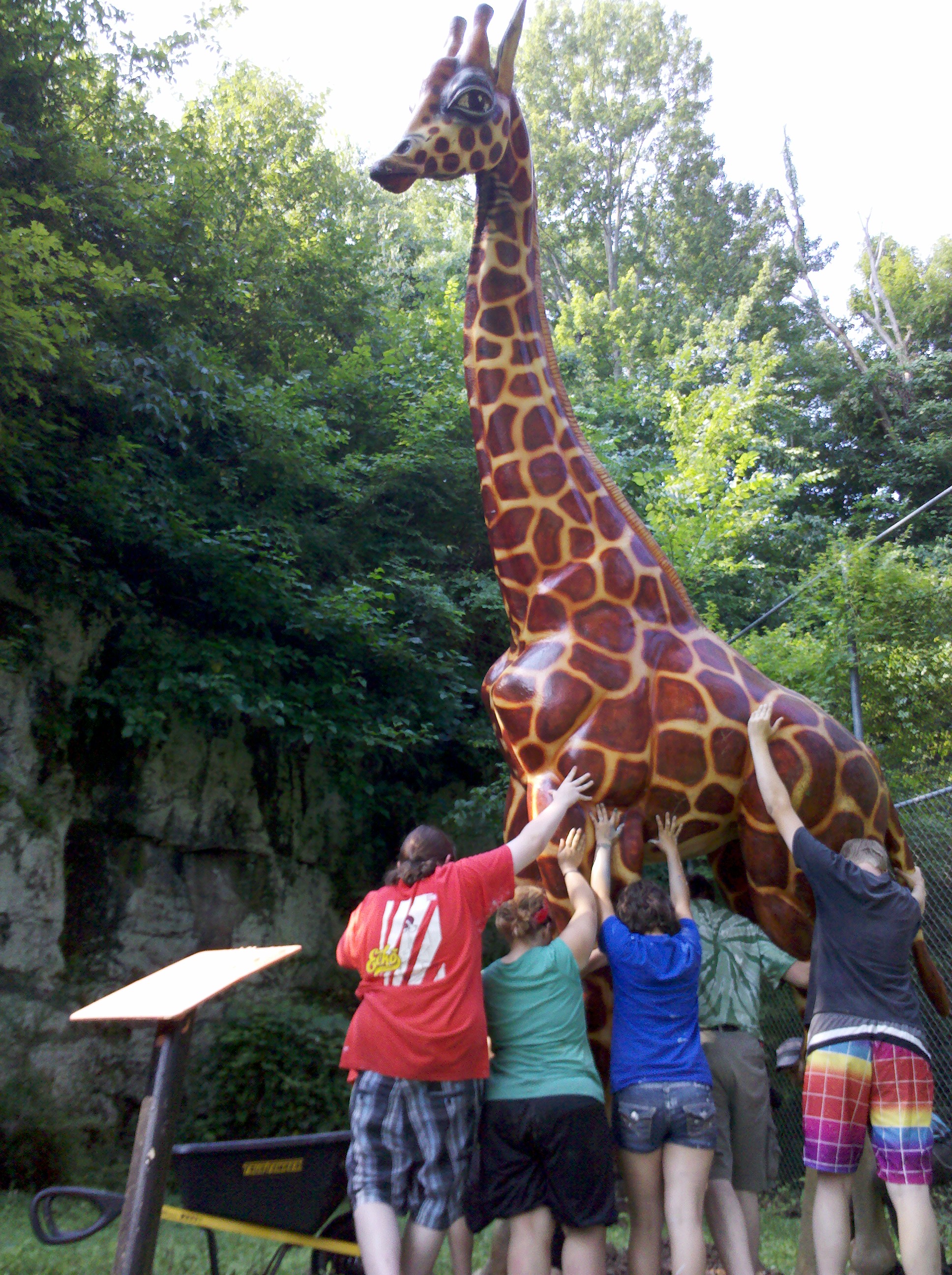
How is a 15-foot fiberglass giraffe like good community organizing?

Picture this: ten young West Virginians carrying a 350-lb fiberglass giraffe through the grounds of a community center in a low-income neighborhood in the Chemical Valley.

It’s a bizarre sight – and it certainly isn’t what the socially-conscious participants expected when they signed up for a summer with Build-It-Up! West Virginia, to build infrastructure and expand the capacity of long-term community-run sustainable economic projects in the coalfields. Continue reading

What’s changed?

It’s hard to believe that we’re nearly four weeks into Summer of Solutions. I’ll be honest–the world hasn’t changed yet. It is still powered by fossil fuels, the income gap continues to expand, hunger and poverty remain rampant in far too many places, biodiversity is quietly but rapidly stepping out, and what’s worse? The steadfast warming of the planet can only enhance these problems.

The world may not have changed (at least noticeably) in the last four weeks, but something has. There’s a mysterious energy I’ve been getting from the world around me that I’ve struggled to place. Something around me has surely changed. But what? For some reason, my perception of the world has become more positive. I have become more and more optimistic about the abilities of people to overcome the daunting challenges posed by ubiquitous, systemic failures. But why? Continue reading

Independence: A Reflection

Two days ago, the United States celebrated the 235th anniversary of our declaration of independence from British Rule. Like most American holidays, we tend to use this as an excuse to have parties, eat a lot, and buy stuff – in this case, fireworks. Many Americans also use it as a time to share their views on patriotism, freedom, and the other concepts our founding fathers talked about – as if the only time it’s appropriate to bring up these words is in the context of the American history or right-wing political rallies.

But when did this language become “right wing”? When did it become cliched/ironic to wear a T-shirt with a bald eagle or an American flag? When did the noble ideal of “liberty and justice for all” become just something we repeat in public school classrooms, not what guides our daily decisions? Continue reading

Ready? Set? Plan!

Cross-posted from WeArePowershift.org

By Anna Nilles

During my first day as a solutionary, I drifted into a conversation among my program leaders about the “side yard wish list.” Simply put, this is all the stuff they wanted to put in the grassy space next to our house. There was mention of chicken coops, bike racks, 3-bin compost systems, tool sheds, and rain barrels. I took one look at the side of the house and chuckled. This would be like when my parents talk about fixing their garbage disposal— it sounds like a great idea, but they never quite get it done.

Little did I know, a week later I would be drafting a floor plan of this infamous side yard and submitting it to a carpenter, who will complete the project next week thanks to a group of volunteers. In addition to fitting all of the “wish list” items into the yard, we will be adding a rain garden, demolishing 2 flights of stairs, and extending the space an additional 8 feet. Continue reading

“Work”

by Daria Kieffer

It is so hot outside. I guess summer finally decided to show itself in Minnesota, and, as much as I love it, I’ve decided to retreat into a nice cold coffee shop to spend some quality time with my laptop. I’ve officially been living in the Twin Cities, working and playing with Summer of Solutions, for three weeks now, and it’s been a crazy blur of activity the whole time.

It’s funny- when I think about all that we’ve been doing for the past 21 days (farming, repairing bikes, meeting with millions of community partners, potlucks, more meetings), I wonder why I’m not about to keel over with exhaustion. I so clearly remember last summer, when I was working 40 hours per week at a consignment store, and all I felt like doing after an eight hour day was plopping down on my couch with some ice cream. Why aren’t these long days depleting me that way? Continue reading

Solutionary Bliss in the Twin Cities

By Cecelia Watkins

Wake up. Bike from my home in St Paul over to South Minneapolis. Meet up with other passionate people to plan how to deliver 40 free workshops on home energy efficiency to local residents. Attend a fabulously raucous group lunch and engage in a vibrant discussion on how capitalism fits into our vision of the green economy. Learn about urban bee keeping, then bike back across the shimmering Mississippi to repair donated bikes and laugh with a motley crew of community members while learning how to distinguish brake from shifter housing. Bike home under blue skies, listening to Jamie Oliver’s Food Revolution TED Talk on my MP3 player.

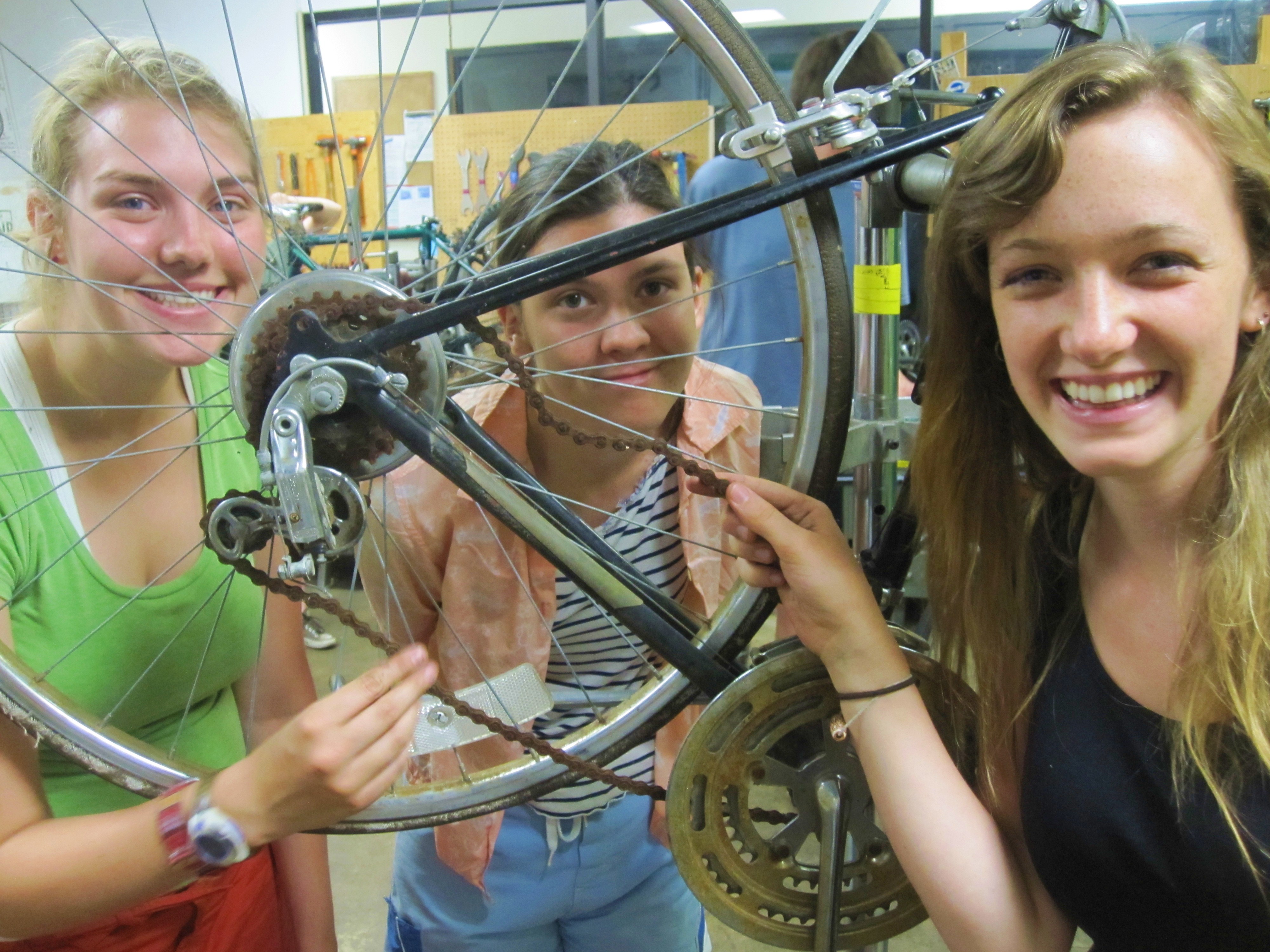
Kirsten, Elena and Daria show off a rusty chain at Sibley Bike Depot

A year ago, I would have termed that a youthful fantasy born out of an head too full of wanting to do it all at once: biking and gardening and weatherizing—making a positive difference in the world while growing personally and maintaining personal well-being in the process. Now, I would call that description a Monday at Summer of Solutions Twin Cities.

Continue reading

June, It’s been nice to know you.

Welcoming visitors

For us folks up here in the Pioneer Valley, things have really been picking up. Today some of us headed out to Harvest Moon Farm where We met up with some old and new friends, one of the teams for New England Climate Summer. New England Climate Summer is a summer internship program for young people that travel exclusively by bicycle in small teams across New England, spending about a week in a community before biking on to the next.

The five strong young women,  Marina, Kaia, Lisa, Sara, and April helped us weed our garlic beds and add new mulch. In addition, we harvested our first zucchini and summer squash, with our largest zucchini measuring 1 foot long!

June, it’s been nice to know you


As the end of June begins to wrap up the first 3 weeks of our program, we have had quite the journey through training days, farm working days, meeting each other, growing, exploring, and asking the questions we hope to spend our summers trying to discover answers to.  Although our team works incredibly hard and is dedicated to our work, we know how to have fun as well.  So what have we REALLY been up to recently?

In the time between our long days of trainings and hours in the hot sun weeding garlic, we have found ourselves laughing and joking, and learning each other’s unique charms and quirks. Skateboarding, frisbee, silly games, jam sessions, dinners; our days extend much more beyond the traditional 8 hour work day.

Swinging at Greenfield High School

Learnin’ some new skills

Pioneer Valley Summer of Solutions Hits the Ground Running

Pioneer Valley Summer of Solutions Hits the Ground Running

Posted on June 18, 2011 by erikajean16

About a dozen of us filled the living room, sitting on all surfaces available and balancing plates on knees or floor boards. The room was full of relative strangers, from high school up to mid-20s, from nearby towns and every corner of New England, sharing company and a meal of lasagna. Energy was high as we discussed the projects that lie ahead this summer, and the ideas we have for our two months together.

This is Summer of Solutions Pioneer Valley, a program in sustainable community development and youth leadership, based in the towns of Turners Falls and Greenfield in northern Massachusetts.

We are a group of about fifteen full and part-time members who are all dedicated to learning how to create solutions in our communities. This summer, that means working on a local farm, learning home weatherization techniques, improving our bike maintenance skills, facilitating and organizing free local classes on topics from food preservation to stone-masonry and much more. Beyond these tangible skills, we’re learning the pieces that make it all fit together.

How do you start a community project? How can you make environmental solutions accessible? What is solidarity? What does it mean to be a sustainable business? How do you sustain yourself while you’re at it?

Working with an exciting variety of community partners, our participants will have the chance to:

1. Become competent in bike commuting and bike maintenance. In our rural corner of New England, cars are a near necessity. We will explore how transportation in our area can become more sustainable, starting with ourselves.
2. Grow their own food and share it with the local community. Through a partnership with Harvest Moon Farm, we will be doing a “workshare” to exchange our labor for produce. We will also be creating a garden at a local community resource center, the Brick House, to provide food and education in the center of Turners Falls.
3. Weatherize a local home and public building under the guidance of a local cooperative, Co-op Power. We will also develop materials to help renters secure energy audits and improvements on their homes.
4. Take and facilitate courses at the Brick House Summer Workshop Series, which offers free classes to the community on topics from gardening to wood working to meditation.

Summer of Solutions goes beyond the tangible work we will be doing, to instill a mindset for the rest of our lives. It’s the mindset that we have everything we are looking for to solve environmental, economic and social challenges. It’s the mindset that people are the key ingredient to make the changes communities are desperately seeking. It’s the mindset that the future can actually look brighter than our present today, and rolling up our sleeves to make it so