Shout-out for Oakland

Hello, my name is Lucy. I’m 15 and I enjoy working with my community, helping others, and focusing on goods and bads in the community. Working with SOS I learned how to interact with others in the same house, how to approach a need and how to communicate with ideas. I really like waking up in the morning knowing I’m going to change my community. Living in Oakland has been my home for 15 years. The community I live in, Fruitvale is my family. SOS has helped me do things I never thought I would do, I’ve been helping with the summer camp at Peralta Hacienda and it’s made me feel like a kid again. The summer camp has welcomed me to a new view of what these kids see in their community. Summer of Solutions Oakland has been a good program for me, here’s where all the teens should come and help out. This program out of all the programs I’ve bee too is one of the bests. I could be at home watching TV and not do anything, but I decided this year it was going to be different for me. I love working in a community where everybody has a lot of ideas for the community. I also like seeing the people in my community helping out. This is all thanks to Summer of Solutions Oakland.

Thank you.

Moving Forward and Analyzing Our Data

Sunday, the Portland Enrichment team went to the Lents Farmer’s Market. Across the street, the Ramona Street Fair was also going on. Some of our partner organizations were on display on Ramona and numerous people were visiting the different tables on the corner of 92nd and Foster.

At our meeting on Thursday, our group had discussed our approach and strategy for getting people to listen who we are and what we are trying to accomplish in the community. Our group’s idea for the farmers market was to play a quick and simple trivia game with the people that came by our table. We called it “Foster Trivia” (Foster is one of the major streets that runs though Lents.)

Examples of questions we asked people were: How many people live in Lents? Who was Lents named after? How many grocery stores are in Lents, and what year was Lents founded? Some of these questions are hard to get exactly right, but a surprising amount of people knew the answers to our questions spot on. Weather people knew the answers to the questions or not, they were happy to take a free lollipop off of our table… everyone likes lollipops.

Nearly everyone at the Market lives right in the Lents area, and most people that talked with us wanted to take our survey after learning a new fact about the town they lived in. I was able to learn a lot of facts about Lents on Sunday and heard some exciting stories as well.

Leo Qin, and the data management team, presented the mid-season report on the feedback Portland Enrichment has accumulated thus far. His report first describes our program and what we do and then he described our team’s methodology for collecting our neighborhood feedback. The three methods we collected data through were in person canvassing, tabling at the Lents International Farmers Market, and through online submission.

The data management team analyzed what people said in the community survey questions. Questions we asked were broken down into eight categories: favorite things, overall experience, relative importance of livability, highest visions, areas for growth, concerns about development, and barriers to health. For each category, a word cloud was created which showed the most commonly used words from people for that particular question. For the “favorite things” category some most commonly said words were: community, diversity, affordable, proximity, parks, Farmers Market and quiet.

There are also graphs to show what community actions people chose to take so far. All of the community actions were well represented and fairly popular. The eight community action categories were: Local Community Energy, Food Security, Resource Sharing, Watershed and Habitat, Community Engagement, Community Investments, Community Spaces, and Diversity and Healthcare. The Food Security action was the most popular action chosen by residents, accumulating for 21 percent. To view our mid season report visit pdxenrichment.org.

Weekend Warriors

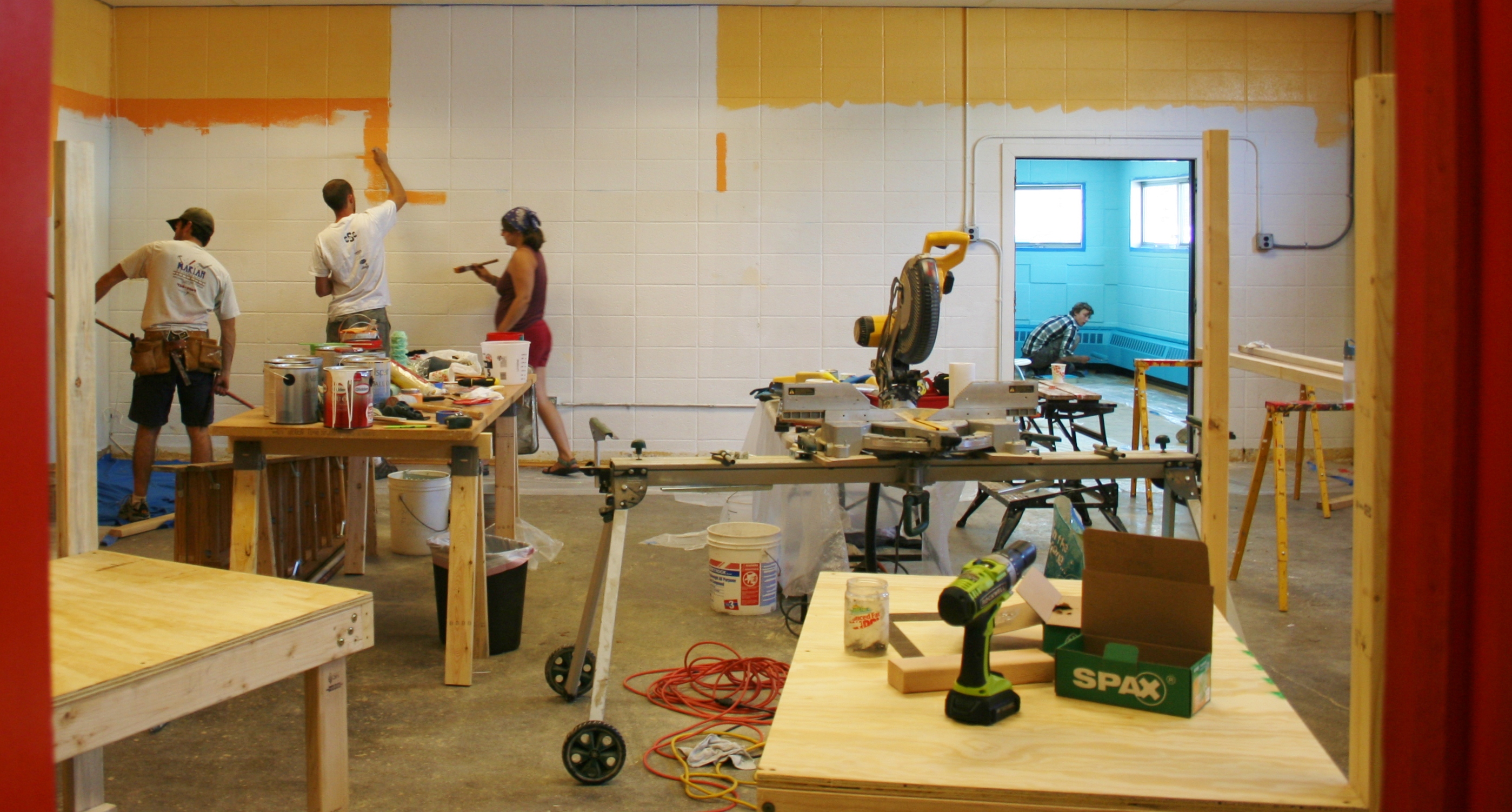
Last weekend in the Twin Cities, SoS participants and community members came out to donate their time and talent to building the SPOKES Bike Walk Connect Center. Everyone who walked through the door was greeted with a smile, a tour and a paintbrush. In one weekend SPOKES went from white drabby walls to a vibrant place for the community built with love and a steady hand from many supporting community members.

Image

Daria, Twin Cities Program Leader and epitome of a SPOKES Weekend Warrior.

Image

Fun on the Job. Painting the main room of the center.

ImageEveryone hard at work and painting away.

ImageBuilding work benches for the bike mechanic stands.

ImageHard work deserves a hearty lunch break. We love our Pizza Luce in MN!

ImageDonated bikes for parts and repair.

Image

Now, a bright and happy space!

Courtney Dowell

Summer of Solutions Twin Cities

Seedlings

Been waiting to start growing your own food?

Start today! Track down some healthy soil, exchange some change for seeds at your grocery store, and find some old newspaper. Tony will show you were to take it from there.

Excerpts from Minneapolis

Part of the reason why I love Summer of Solutions is that I’m learning an incredible amount by doing hands-on work that includes gardening, speaking at community meetings, and building and painting at Spokes bike center. As much as I am empowered by these learning experiences the value of classroom learning cannot be discredited. In fact, one of the most remarkable aspects of the Summer of Solutions Twin Cities program is our EXCO class, Climate Solutions, Economic Renewal, and the Energy Transition.

EXCO, Experimental Community Education of the Twin Cities, offers free classes that anyone can teach or take in order to build a community around social change. Summer of Solutions’ own Timothy DenHerder-Thomas teaches Climate Solutions, Economic Renewal, and the Energy Transition. My favorite part about this class is that I never know what exactly to expect, but I am sure to leave feeling awakened by the conversations that are shared.

For example, our first class was spent sharing our experiences with community and the environment and I left with a feeling of camaraderie with my fellow Summer of Solutions Twin Cities participants. One class was spent labeling all the climate changes we’ve ever heard about on a giant world map… I have to admit this particular lesson left me slightly depressed, but I was glad to learn all that I did about strange weather phenomena, fossil fuel dependency, and more. During my favorite lesson (so far at least!) we shared our ideas of what would convince the world that a sustainable, green economy can work. The brainstorming, collaborative thinking, and creativity I experienced during that class left me feeling so invigorated and excited to be a part of the environmental movement.

Overall I’m thrilled to indulge in so many different avenues of learning through Summer of Solutions Twin Cities!

Zelalem Adefris

Daybreak in East Oakland

I’m sitting on the back porch of the Harrington House. The early morning sun grazes the top of the plum tree to my right and the arms of the cactus that hovers over the chicken coop. Our neighbor’s pit bull is still curled in a tight ball on the other side of the gap-toothed picket fence. Beside me, peaches and tomatoes from farmers’ market donations ooze quietly in their cardboard boxes. All is still and breathing softly in the limbo time between night and day.

The coffee in my cup cools and curdles in response to my blatant neglect. I had made it out of habit, and without really wanting it; I am already awake and painstakingly present in the evolution of this moment. I reflect on the passing of time.

Just two weeks ago the plum tree was in peril, overburdened and breaking by the weight of its fruit; the yard was a monolithic slab of hardened dirt, flecked with glass and broken pottery.

Sometime before that, I was still scraping paint off the kitchen floor and when I walked outside and across the street in search of a broom, I saw two children pushing toy trucks back and forth behind a chain-link fence. The paint is gone, but the kids are still there.

Just a month ago, we were unlocking the doors for summer camp. Bienvenido. We were standing before a cluster of concerned parents, who hoped to entrust their children in our care. We were drafting forms and counting kids, bright smiles and big brown eyes.

July 4th came and went with gunfire. The same sound that woke me last night. I had rolled over and gone back to sleep. This is East Oakland. We could be working somewhere else, a place where the roads are smoother and the nights are quieter. But that’s not really the point, is it? The conflict, and all this cracked concrete is a gift, a catalyst of growth, a cause for celebration.

Back in June, we were sitting in the garden for the first time as a team. We had shared our goals, and dreams, and fears. The people and plans are still solid but the details are warped and hazy in my mind’s eye, like a scene viewed through frosted glass. Peering into that memory, it seemed like we were starting with nothing but the vagaries of positive intentions. I quickly learned that abundance comes to those who call upon it.

It came in the form of dirt and sweat and donated art supplies; helping hands, eagerness, and compassion.

With this abundance, we hacked up the hardened earth and sprinkled the soil with the same intention of regeneration that we showered on the summer camp.

This morning from my perch I can see the garden beds down below me and the camp curriculum for the week blocked out on butcher paper by the door. We are not here to SOLVE anything or SAVE anyone. But every day, I am amazed by our ability to collaborate, to move forward while honoring where we have come from and where we are standing now.

Growing Roots

One may never notice, when walking down 24th and 17th ave. in South Minneapolis, the abundant community garden oasis that sits in the middle of this block. A group of us solutionaries have been working over the past couple weeks at the permaculture garden with Lynn Mayo, a passionate woman full of agriculture wisdom who initiated the gardens in 1990’s. Much of what I have learned working at the permaculture gardens, has been through experiences and tasks, like shoveling soil for a green house, planting morning glories, harvesting garlic, or learning the proper technique for rolling up a garden hose.

On Tuesday, Maddie and I were weeding in the 17th ave. garden, to prepare a plot for planting. There are times when we are kneeling in dirt, with our hands in soil, and the sun on our back, that I forget that we are in a city. This is a wonderful sensation, but on Tuesday when I dug my hand in for weeds, I found yellow plastic. I pulled the object out of the dirt and brushed off the soil to find that this was a yellow razor. I don’t think it is all too common to find yellow plastic razors in the soil on farms out in the country; nor is it probably common to find candy wrappers, sharpie pens, toothbrush, glass shards, and other various trash that we find while gardening on the block. So, it turns you can find a lot more than plants in a garden. I do have to emphasize though, that the joy and fulfillment I have gained from working in Lynn’s garden, far outweighs finding a bit of trash sometimes.

We continued to weed in the garden, and as Maddie dug into the soil, she came across a deep and plump root. If one has weeded before, they know that rich satisfaction one gets from ripping out a full weed, from stem to the tip of the root. Maddie is familiar with this too, and as she dug, she could not find the tip of this root. When working in this city garden, one seeks to dig up as much substance and knowledge as we can. In Maddie’s case, she was seeking the satisfaction of getting that root out of the soil. After tugging out 5 feet of the root, about equal to Maddie’s height, Lynn walked by and Maddie asked about what she could do about this. Lynn said, “that’s the root of a tree, leave it”.

Keep digging, and we may find that these roots run deep. Keep digging in these gardens, and we may find the roots of an entire tree. Well, that wasn’t quite the weed we expected to pull, but we are students, and we are digging, and learning, as we garden away.

Carrie dV-M
Twin Cities SOS 2012

The Buzz in Middleton

Cross-posted from Growing Food and Sustainability

This week Growing Food and Sustainability was fortunate enough to have Heather Swan give a talk on beekeeping during one of our training sessions. Heather informed us about behaviors and beekeeping practices as well as bee’s importance in agriculture as pollinators. She also gave insightful anecdotes about her own personal experience working with bees. When she was done we sampled some honey, such as the light and highly prized tupelo honey to the rich and molasses-like buckwheat honey.

Heather taught us many fun facts about honey bees:

-A healthy colony may contain as many as 60,000 worker bees.
-2,000,000 flowers must be visited to create a pound of honey.
-During the winter, bees will form a cluster in the center of the hive and vibrate to create heat. The center of the cluster may reach up to 81 degrees Fahrenheit.
-The military has used bees to locate explosives and illegal drugs because they have an extremely sensitive sense of smell.
-When bees are “swarming” in search of a new hive, they are in their least aggressive state.

Back in the garden:

We harvested our first cabbages and radishes. Plenty of rain and few weeds meant slightly less work in the garden itself. We have also been making kale pesto and screen printing T-shirts in preparation for our Harvest Festival on Saturday, August 11th.

A personal note:

I will be leaving Middleton this weekend and as such will not be continuing to work with GFS this summer. It was a pleasure to meet all of the hardworking participants with whom I grew, delivered, preserved, ate, composted and appreciated vegetables. This summer I got closer to my food, literally, thanks to GFS.

Sustain your Growing,

-Matthew

Garden News

Cross-posted from LetsGoChicago.orgThe Eye of the Storm

With the end of the summer coming into view, our seedlings are long gone and the harvest is nearly here. The garden is full of life, and this week we’ll be completing this summer’s planned gardens. We’re currently tearing up the grass on a front lawn on the 6700 block of Ashland, so if anybody has seen the construction, yep, that’s us.

Biodiversity is crucial to a healthy garden, and we’re happy to see all manner of bugs and beetles all over the place, fighting it out to make sure nobody gets to sit around and eat the produce. We haven’t yet figured out how to keep yellow finches off of the rainbow chard, and we certainly didn’t expect to find this:

Bunny City

At least three baby bunnies have been sighted in our ‘home base’ Bosworth backyard garden, and they’re almost too cute to consider them a pest.

We’re also learning how to put new things together outside of the garden, and in the last couple of weeks we’ve built sub-irrigated planters, swales, cold frames, A-frame levels, worm compost set-ups, and reclaimed lumber raised beds. We’ve learned how to save seeds, mulch with weeds, and dumpster dive both food and materials. Maybe the most spectacular, though, was last week’s paper-making workshop:

Once a Pulp, Always a Pulp

This week we’re learning about bee keeping, so stick around for the inside scoop!
Ben