Expanding My View of Agriculture

One of my job titles for the summer is “mushroom specialist”. This means that my car is full of big orange 5 gallon buckets, my freezer is full of coffee grounds, and sitting on my kitchen table is a 5lb block of sawdust inoculated with shiitake mushroom spores. Although my job title is mushroom specialist, I must admit that I can’t remember the last time I ate a mushroom and before this summer I didn’t know much about them. When I signed up for Summer of Solutions- Twin Cities I knew I wanted to do something with urban agriculture. I figured I’d be weeding a couple of gardens, maybe harvesting a crop of carrots or beats, and if I got lucky I might even get to take some of the produce home. Since I’ve started working with Summer of Solutions my idea of urban agriculture has expended. I don’t just think of big community gardens and rows of carrots and beats. I think of tilapia, vermacomposting, and of course mushrooms.

Did you know that mushrooms can break down radioactive waste, and then be converted into bio-fuels? Or that mushroom mycelium can be used as a filter to remove biological contaminants from surface water that pass directly into sensitive watersheds? How about that the waste substrate from many mushrooms can be used as feed for animals or as garden compost? Mushrooms are amazing organisms and when I learned some of the cool things that they could do I knew I had to know more. So I volunteered to become a mushroom specialist for Yea Corps.

Yea Corps is a partner of SOS-Twin Cities that works with schools in Minneapolis to empower youth with job skills and sustainable education. A major component of this mission has been the development of an aquaponics system that gets students to think about closed loop systems and new ways to view waste. This summer nine SOS interns will be working to maintain what Yea Corps has done in the past, and expand on their vision for the future. For me that means cultivating mushrooms. For other interns it means building a new aquaponics system, growing algae to feed the fish, or producing videos to share the mission of Yea Corps. For all of us it means finding what interests us and seeing how we can apply that to creating a green economy. It’s exciting to think about where all of this will take us and how we as a group can expand the way people think about agriculture.

Building up community immunity

During High School I volunteered at a local food shelf and
was discouraged to see the same people for almost the entire year. It made me realize that much of my efforts were merely a small, cheerfully-printed band-aid on a pervasive wound that wasn’t just skin deep.  If anything it masked the true nature of poverty, which requires larger shifts in political and social norms.

Though band-aids can suffice in some instances, other problems need an alternative, more direct type of treatment.  What I’ve been learning this summer about community organizing for environmental justice can best be explained by Paul Hawken’s analogy about antibodies in his book Blessed Unrest.” Hawken relates environmental and social justice groups, like Summer of Solutions, to antibodies which are essential for our immune system.

They arise as a response to foreign invaders and systematically undermine threats to our bodies, like viruses and certain types of bacteria. Antibodies will collaborate with B cells to create a “blueprint” after they combat toxins, so that more antibodies can be created quickly if the same type of toxin returns. Also important to note is that “the immune system depends on diversity to maintain resiliency, with which it can maintain homeostasis, respond to surprises, learn from pathogens, and adapt to sudden changes.”

Summer of Solution’s is an antibody. It’s anti-oppression sessions and focus on social entreprenuership has challenged me to identify and address the root causes of social and environmental injustice in my community while being watchful of a “savior mentality.”

One of my projects this summer has been to work with Cooperative Energy Futures. CEF seeks to make insulation and weatherization more affordable and to educate people about other ways to improve energy efficiency. Their focus is to empower people to improve their home energy efficiency and generate savings.

I’m still figuring out what effective community organizing looks like, but like the immune system, it is diverse. It needs to draw on the resources available and be able to adapt quickly – and ultimately find a way to create homeostasis.

-Kirsten Theden

Mid-Summer Reflections on Social Entrepreneurship in Raleigh

It’s so hard to believe that it is already July!  This time last year, I was feeling disappointed wih the present and anxious about the future.  Like a lot of young people, I had graduated from college and discovered that the recession I had been reading about in the newspapers wasn’t just notional.  Jobs were scarce and the ones that I could find barely paid the bills and in no way satisfied my desire to help build a sustainable, restorative economy, which I believe is our generation’s calling.  I still volunteered a good deal of my time as a climate justice advocate, but I was stir-crazy for a change in strategy.  I was expending a lot of effort trying to convince people with “more power” than me to change their historically selfish and stunningly short-sighted policies and attitudes so that I could have a secure future along with generations to come. This approach didn’t seem to be bearing change at the speed and the scale that we needed it to.

One afternoon, on an especially gloomy day, I decided to outline the most meaningful, world-transforming vocation I could imagine for myself, the sweet spot between ‘What the world needs,’ ‘What I am good at,’ ‘What I enjoy,’ and ‘What provides for my life.’  I described a vocation in which I would work with girls to advance gender justice, economic justice, and environmental justice.  The injustices perpetrated against girls and women, money-poor people, and the earth itself have proven themselves exceptionally persistent and are fundamentally connected; they cannot be addressed in isolation of eachother.  However, their connection also represents enormous potential – by advancing genuine economic justice, we advance genuine gender justice and environmental justice (and vice versa all the way around).

My vocation would be a combination of some of the ventures I most admire – the Harlem Children’s Zone, a poverty-eradication with a long-term (birth through college), community-powered approach;  the Green Belt Movement, a venture started by Wangari Maathai that addresses deforestation in Kenya by empowering women economically; and the Grameen Bank, which has transformed rural Bangladesh through its world-renowned microlending program.  ‘Full Circles Foundation’ would matriculate girls as kindergartners – specifically girls who have high potential but face big obstacles.  These girls would be paced thorough a long-term series of best practice programs including:

– summer camps and afterschool programming focused on the connections between personal, community, and environmental health;
– a community organizing training program through which they identify an improvement they would like to see in their community and build a campaign around it;
– apprenticeships with local artisans and small businesses;
– and a microventure program that would give the girls social entrepreneurial experience as well as generate resources for summer camps and after-school programming.

This was all just an outline in my journal until I started hearing murmurings about the idea of social entrepreneurship – a strategy of sustainable change that works to leverage the wealth that surrounds everyday people to build the new, restorative economy.  I was so different from the charity and advocacy models I had been working through!  I first heard about this idea from Grand Aspirations (www.grandaspirations.org), an organization working to build social entrepreneurial capacity among young people and to connect them, their experiences, and their models.  I submitted my still-vague outline to Grand Aspirations in hopes Raleigh would be selected as one of their national “Summer of Solutions” sites – cities around the country where young people gather from June to August to get elbow-deep in the birthing of the new, restorative economy.

Looking back, it was a somewhat spur-of-the-moment decision to submit that application – Full Circles Foundation was a crazy dream and it was difficult for me to suspend my skepticism at my own idea enough to even imagine that such a thing would be possible.

But thankfully, I was able to do so long enough to finish and send in our application, and on Friday, July 1, the Full Circles Foundation’s 10-person pilot team wrapped up Strong Home Camp, the first installment of the Strong Camps, a series of free, holistic summer day camps focused on illuminating the connections between personal, community, and environmental health!  We have been working with approximately 20 girls whose ages range from 4 to 15.  Strong Home Camp was focused on fostering environmental literacy through place-based education.  It was an adventure!  Most of our girls had never been on a hike, been on or in a natural body of water, or asked a tree a question – things they were asked to do for the first time during Strong Home Camp.  Among many other great workshops, campers rolled up their sleeves in food labs with whole, local food, learned about the mathematical mysteries found in nature, and made all-natural body lotion. This camp will be followed by Strong Self Camp (creative communication and personal health & wellness) and Strong Neighbor Camp (community health & engagement).

One of the most exciting features of Strong Home Camp was getting to make Flower Bombs.  Flower Bombs are concentrated balls of compost, clay, water, and wildflower seeds, that when dehydrated become virtual “bombs” of perennial flower power!  You can throw them in your backyard, in vacant lots, or on the shoulder of roads, as a way to enliven our communities with color and aroma.  Flower Bombs (and “bombs” of edible plants) became popular through the ‘Geurilla Gardening’ movement – a effort spanning the globe to reclaim public spaces and transform them into beautiful (and tasty!) spots for folks to rediscover community.  FCF campers made over 450 flower bombs – a delightfully messy endeavor!  This project was led by Jenn Hales, an amazing artist and entrepreneur in Raleigh who runs the Patina Collaborative (www.patinacollaborative.com).

After making the Flower Bombs, the campers packaged them in cloth sachets which they adorned with hand-made construction paper tags.  On Friday, our campers and instructors packed themselves and their wares onto the Raleigh city bus and headed downtown for First Friday, a monthly event at which the Raleigh community comes out to celebrate our city center, local businesses, and local music.  This was the first opportunity for our campers to raise resources to support their own summer camp.

It was amazing to watch.  The girls were absolutely fearless.  Even our four and five year-olds were explaining the compelling logic of Flower Bombs to potential buyers in between hopscotch rounds!  The environment was so much fun – there were hula-hoopers, fire-dancers, drummers, and community members of all stripes.  It was amazing to watch our campers absorb the experience.  They had had the opportunity to create something that generated social, environmental, and financial rewards – an opportunity that I didn’t get until I was 24! Moreover, through that experience, they became allies. These aren’t girls whom we are “serving”; these are girls (and families) with whom we are partnering to create an unforgettable summer experience that they want!  At some point during the evening, the thought occuring to me, “This is what health looks like. This is the type of world I am wanting to build.”

Implicit in the exercise of social entrepreneurship is the question, “What does the world I’m trying to create look like?”  The beauty and the weight of social entrepreneurship is that WE have to answer that question.  We can’t just identify a problem and shout at someone “smarter” or “richer” or “more powerful” than us to find a solution.  With social entrepreneurship, individuals and communities can’t ‘outsource’ the question of what our world should look like – we have to decide, we have to explore our potential to realize our decision, and we have to take responsibility for whatever the outcome of our decision may be.  But, this is what it means to self-govern; this is what it means to be human.

by Marcie Hawkins Smith, mhsmith@fullcirclesfoundation.org

In Highland Park, A Region Raises a Hoop Hous

http://univercities.wordpress.com/2011/07/06/in-highland-park-a-region-raises-a-hoop-house/

written by Joel Batterman

A barn-raising in the heart of Detroit? That’s certainly what it felt like as activists from across the region gathered in Highland Park on Sunday, June 26, to construct a 2000-square-foot hoop house from plastic sheeting and metal tubes. This solar-powered greenhouse can grow food year-round—even in Michigan winters. Armed with the right equipment, it doesn’t take more than a day to construct one. As UniverCities Energy Data Intern Jordan Eizenga and other Suburbs Alliance staff found, it does take a number of willing hands.

Jordan Eizenga is framed by the house’s metal structure.

Jordan (not to be confused with Energy Policy Intern Jordan G.) found lending his hands easy enough. He moved to Ferndale this summer to be near the Suburbs Alliance main office, and biked the few short miles along Woodward Avenue from Ferndale to help build the house. The site was behind the Green Economy Leadership Training (GELT) house near Woodward and McNichols. A branch of a national youth network organizing for solutions to global climate change, GELT seeks to give young people a holistic understanding of the transition to a sustainable, community-scaled economy through neighborhood projects like the hoop house.

Things heat up in the hoop house’s interior.

By late morning, most of the metal hoops that formed the hoop house’s structure were already in place, and the lot was a hive of activity. Builders included master hoop-house mechanic Jeff McCabe, co-founder of Ann Arbor’s SELMA Café, Margaret Lewis, publisher of the Highland Park-based Legacy News, and scores of others from the block, the neighborhood and the greater region. Now that’s metropolitan cooperation in action! While at rest, the group traded farming tips and enjoyed impromptu rapping from the youngest attendees.

The plastic sheeting has been hauled into place.

“Billow it!” As the sun sank lower, the team gathered on either side of the curving metal frame to push and pull the plastic walls of the house into place, sending ripples through the giant sheets to carry them over the top. Slowly, under the careful hands of Jordan and two dozen others, the double sheets slid down to meet the wooden frame near the ground. What had been empty space open to the elements at dawn became a warmer interior where plants will grow come winter.

Collective celebration with the help of a timpani.

There’s much more to be done before the hoop house produces its first crops. For Jordan and the other six Suburbs Alliance staff on hand, though, the day was an inspiring confirmation that people from all over the area can come together to build a healthier, greener and tastier future. Working cooperatively, the group built in one day what a single person couldn’t have constructed alone. Metro Detroit needs to bring that lesson to a regional scale: we’re stronger together.

Renewable Energy > Nuclear!

In the aftermath of the Japanese disaster, politicians around the globe have been debating the necessity of including nuclear as part of the transition to a clean energy future. Unlike other leaders who have placed moratoriums on the licensing of new plants, American politicians have largely stuck by nuclear–a consensus that perhaps was aided by storm of nuclear lobbyists on Capitol Hill.

But, as of last month, the U.S. renewable energy industry has reached an important milestone: domestic production is now greater than that of nuclear power.

This milestone has been reached by important leaps in the renewable sector, particularly from solar-generated electricity which increased by 104.8 percent in the first three months of 2011 compared to the first quarter of 2010.

While renewable energy still has a long way to go before it catches up to fossil fuels, the recent jump in production could play a major role in a nuclear debate that has often denounced the ability of renewable energy to provide stable and sufficient power. While most people agree that nuclear carries inherent meltdown risks and poses the serious challenge of radioactive waste storage, support for nuclear power was at an all-time high among the American public before the disaster in Japan.

Last February, the World Wildlife Fund released a provocative energy report  of an future world run entirely by renewable energy, set in 2050. The report was quickly followed by two papers from professors at Stanford and UC Davis envisioning a similar future but one solely reliant on already existing renewables, mainly solar and wind.

The tide is clearly changing with more academics, politicians and activists agreeing that renewable energy is the way of the future. Whereas nuclear power plants go for at least $10 billion a pop, Summer of Solutions Oakland is partnering with Solar Mosaic to build community solar projects with investments as small as $100. I know where I’m putting my money…

Cross-posted at  the Solar Mosaic blog http://solarmosaic.com/blog/renewable-energy-nuclear


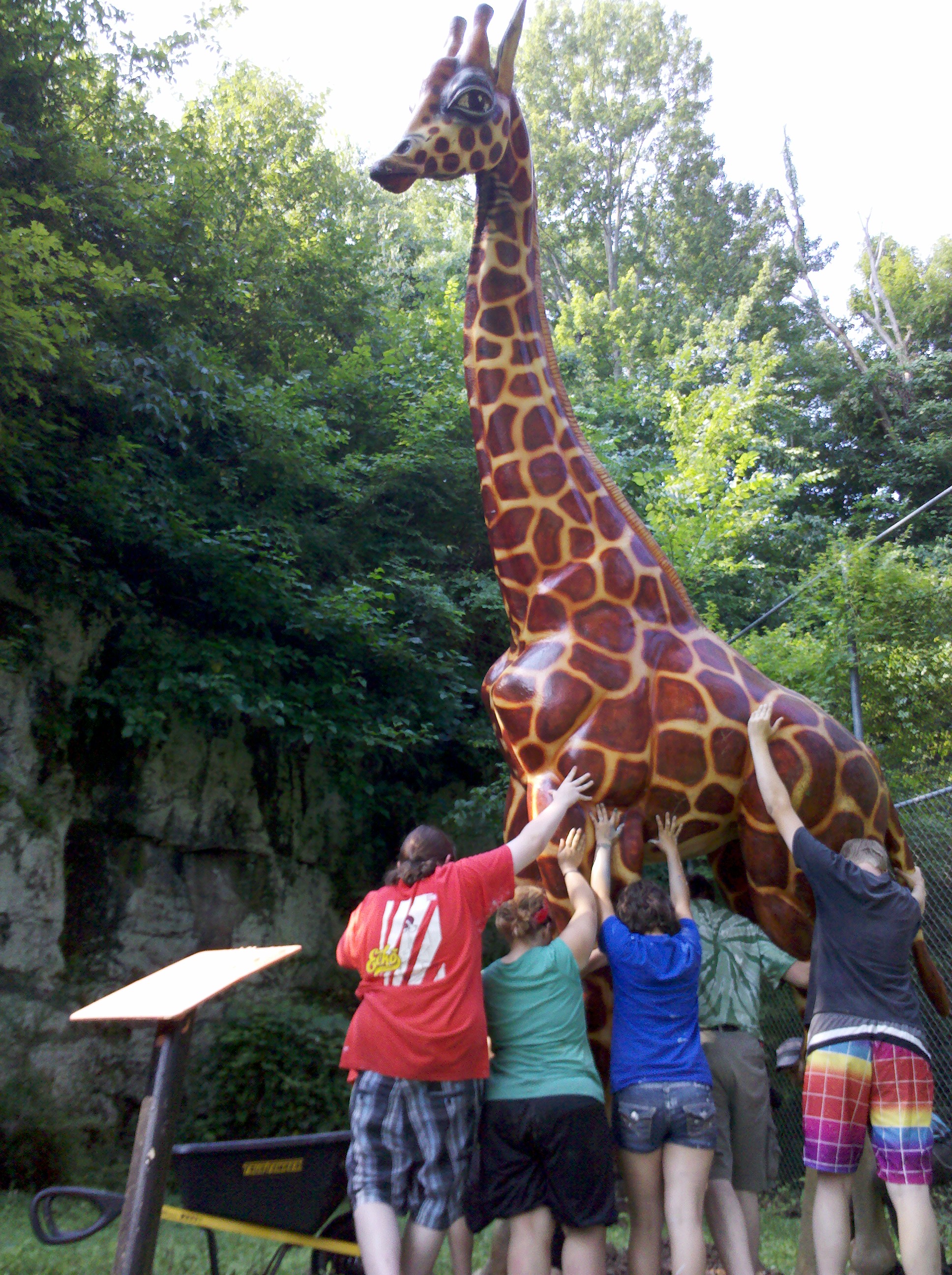
How is a 15-foot fiberglass giraffe like good community organizing?

Picture this: ten young West Virginians carrying a 350-lb fiberglass giraffe through the grounds of a community center in a low-income neighborhood in the Chemical Valley.

It’s a bizarre sight – and it certainly isn’t what the socially-conscious participants expected when they signed up for a summer with Build-It-Up! West Virginia, to build infrastructure and expand the capacity of long-term community-run sustainable economic projects in the coalfields. Continue reading

What’s changed?

It’s hard to believe that we’re nearly four weeks into Summer of Solutions. I’ll be honest–the world hasn’t changed yet. It is still powered by fossil fuels, the income gap continues to expand, hunger and poverty remain rampant in far too many places, biodiversity is quietly but rapidly stepping out, and what’s worse? The steadfast warming of the planet can only enhance these problems.

The world may not have changed (at least noticeably) in the last four weeks, but something has. There’s a mysterious energy I’ve been getting from the world around me that I’ve struggled to place. Something around me has surely changed. But what? For some reason, my perception of the world has become more positive. I have become more and more optimistic about the abilities of people to overcome the daunting challenges posed by ubiquitous, systemic failures. But why? Continue reading

Independence: A Reflection

Two days ago, the United States celebrated the 235th anniversary of our declaration of independence from British Rule. Like most American holidays, we tend to use this as an excuse to have parties, eat a lot, and buy stuff – in this case, fireworks. Many Americans also use it as a time to share their views on patriotism, freedom, and the other concepts our founding fathers talked about – as if the only time it’s appropriate to bring up these words is in the context of the American history or right-wing political rallies.

But when did this language become “right wing”? When did it become cliched/ironic to wear a T-shirt with a bald eagle or an American flag? When did the noble ideal of “liberty and justice for all” become just something we repeat in public school classrooms, not what guides our daily decisions? Continue reading

Ready? Set? Plan!

Cross-posted from WeArePowershift.org

By Anna Nilles

During my first day as a solutionary, I drifted into a conversation among my program leaders about the “side yard wish list.” Simply put, this is all the stuff they wanted to put in the grassy space next to our house. There was mention of chicken coops, bike racks, 3-bin compost systems, tool sheds, and rain barrels. I took one look at the side of the house and chuckled. This would be like when my parents talk about fixing their garbage disposal— it sounds like a great idea, but they never quite get it done.

Little did I know, a week later I would be drafting a floor plan of this infamous side yard and submitting it to a carpenter, who will complete the project next week thanks to a group of volunteers. In addition to fitting all of the “wish list” items into the yard, we will be adding a rain garden, demolishing 2 flights of stairs, and extending the space an additional 8 feet. Continue reading