Summer Wrap-Up in Raleigh

by Tom Frakes of the Iowa City Summer of Solutions.

As the summer draws to a close, it’s easy to feel nostalgic for those sultry mornings spent with local food producers, conservationists and community gardeners when the July sun shone through hazy skies. Even those long hours spent in the office are becoming a happy memory. Our participants in Iowa City Summer of Solutions have a lot of work to reflect on and be proud of, and we’re especially thankful for all the support that our partners and the Iowa City community at-large gave us. Part of our mission has been and will continue to be building a lasting relationship with this city and its residents, and everyone in our organization looks forward to carrying the torch into 2012 and beyond.

Iowa City was one of fifteen communities nationwide to host a Summer of Solutions program, with several more being added for the 2012 operating year. Our parent organization, Grand Aspirations, is actively fostering new programs in rural areas, college towns and major metropolitan communities across the country. While the focus of each program is local and dencentralized, the need for national cohesion and community sets the stage each year for the August Gathering in a Summer of Solutions host community. This year’s gathering was in Raleigh, North Carolina…a city who has earned international notoriety for its emphasis on green economics and green collar job growth in addition to its established scenes in academia, research and the arts. Our partners in Raleigh were phenomenal hosts and graciously introduced us to their community. Iowa City was able to send four team members to the week-long conference where all SoS programs could showcase their ongoing projects, share successful models and methods of community organizing, and contribute to Grand Aspirations’ national vision and strategy. This was a truly rewarding experience for our members who traveled to Raleigh, and will provide lots of innovation and resources for the Iowa City program.


Thanks to generous donations and fundraising opportunities from community partners such as the University of Iowa’s Office of Sustainability, the City of Iowa City Recycling Division, Enterprise Rent-A-Car, Dairy Queen and Cold Stone Creamery…our team raised enough money to drive to North Carolina for the week to participate in this vital conference. We were also able to cut the drive in half with a one-night camping adventure in the Great Smoky Mountains National Park. This park is famous for its accessibility (trails aplenty and admission is free), its range of microclimates, and its biodiversity and endemic species. This was not only a great place to break up the seventeen hour drive, but also was the first chance any of the Iowa City delegation had to visit this park with its inspiring vistas and wildlife. We learned about the stress the park is facing from invasive species and acid rainfall despite its unspoiled appearance to the untrained eye. We also had several opportunities to learn about Appalachian history and the cultural heritage of the region. We walked the Appalachian Trail near Clingman’s Dome at 6,500 ft. above sea level and listened to native bluegrass music on the Blue Ridge Parkway on its way into Asheville. Even before reaching the conference, the August Gathering had given us opportunities of a lifetime.

After descending from the Smokies and crossing the park and plantation landscapes of the Piedmont, we arrived in Raleigh in high spirits. Immediately we got to work meeting colleagues, setting norms and goals and settling in for a week of focused workshops. Almost fifty participants from across the United States joined together at the Umstead Park United Church of Christ, who donated its fantastic and LEED-gold space to Grand Aspirations for this year’s gathering. Within hours we had set the tone for the week, met dozens of visionary peers ranging in age from 15 to 31 and in backgrounds from Oakland and Detroit to Arkansas and West Virginia. If ever there were proof that youth leadership and the sustainability movement are alive and well, this was it.

The week progressed and so did our conversations and our work, despite the levity added by earthquakes and hurricanes in the region. We awoke at dawn on Thursday to strange pressures and skies, as the atmosphere was palpably charged from the impending hurricane. The woods were very still and quiet that morning in anticipation of the storm. Despite these events, the whole group enjoyed visiting parks and coffeeshops in downtown Raleigh, held a beautiful fundraising event at the Mahler Fine Art Gallery within sight of the capitol building, cooked delicious food for each other at mealtimes and spent eight or even nine hours each day hard at work in sessions, workshops, breakouts and program spotlights. We also participated in a talent show and, when time permitted, spent evenings relaxing and building relationships with our colleagues. Overall, the 2011 August Gathering was a tremendous success despite natural disasters, travel logistics and a pervasive lack of sleep.

We left the Carolinas on Friday evening with the outer bands of the hurricane moving inland and gusty winds picking up from off the Atlantic. Irene was visible in our rear-view mirrors all the way across the Blue Ridge and the Alleghenies where she rained on our rental car with gusto. It wasn’t until we reached the coal fields of West Virginia that the skies cleared and temperatures dropped. Before we knew it, we were crossing the vast landscapes of Indiana and Illinois. The sun rose crisp and bright on the banks of the Wabash and by 9am we were home, alive and well, simultaneously stimulated and exhausted.

We here in Iowa City believe that each SoS program and Grand Aspirations as a whole will benefit from the work accomplished and relationships forged in Raleigh. Motivation is running high; maintaining it will be paramount to our success as obligations to work and school are established this fall. There will be challenges, but with the vision and support networks established in North Carolina, Iowa City SoS is eager to face them. We want to reiterate our heartfelt thanks to our partners in Iowa City, in Raleigh, in the Twin Cities and across this great country in setting the stage for an incredible and proactive 2012. Check our website,Twitter and Facebook pages often for volunteer opportunities and upcoming events. Good luck to all our peers and supporters this fall, and thanks again to Iowa City for being a great community to work with!
Hands in the Soil

Aside

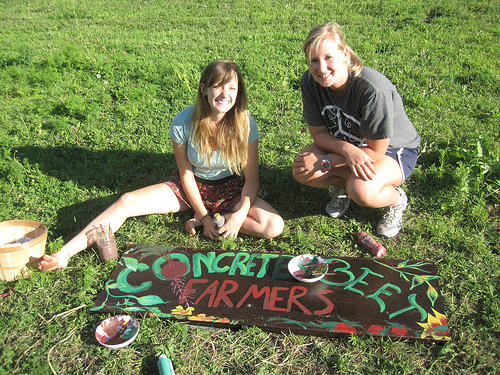
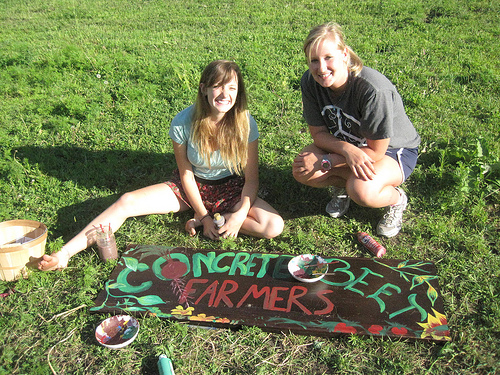
Daria and Paige with the Concrete Beet sign made from a salvaged piano.

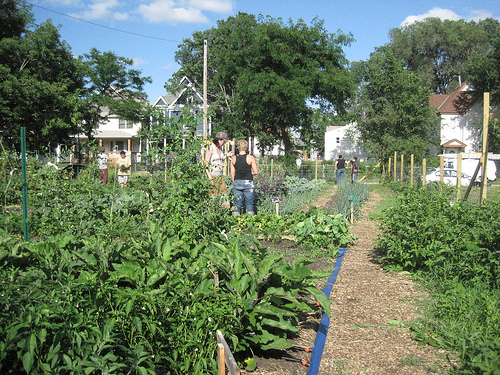
This morning I tumbled out of bed and made my way to the Concrete Beet farm, where I have been learning hands-on urban farming. On Thursdays and Sundays, the Concrete Beet harvests vegetables for ten CSA shares. When I got there today, Emily and Emily were strategizing the order in which the produce would be picked, cut, dug, etc.

*Linda in front of some potato towers

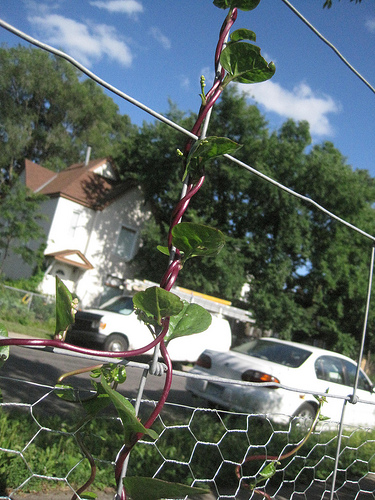
Tall Emily got out her steel snips and started the process of un-furling the wire-fencing around a potato tower* while I picked the kale from the top of said tower. I was not expecting much from this particular potato patch, because of previous weeks’ harvesting of underwhelming spuds. This week was different. As soon as the tower was unbundled, we started pulling out huge round red taters.

When Anna, another S.O.S. participant, showed up, we were left to dig through the mound of soil and plants. I noticed how dark and rich the soil was as I ran my fingers through it, disturbing the tiny creatures that lived in it. They scattered as Anna and I chatted and pulled clumps of earth apart.

My hands and fingers are the same as my father’s mother’s. She died in 2008, and I wear her rings, which fit my fingers perfectly. As I was reaching my fingers into the earth, I thought about her, and about the hands of all of my ancestors who put their hands in the earth and brought food from their efforts. Some were German, some English, some Irish, but most were farmers.

I said something to Anna about my Irish ancestors, since we were digging potatoes. I associate potatoes with my being in this country; since my primary education about immigrant history is that the majority of Irish influx to the United States was due to “potato famine.”

Lost in my reverie, I thought about the recurring themes that have lead people to leave their homelands and seek out a new beginning thousands of miles away.

The Irish Potato Famine was exacerbated by (English) absentee landlords who charged a premium to poor tenants for small pieces of land on which only potatoes could be grown in enough abundance to be a staple food throughout the year. When the potatoes failed, everything toppled for the Irish. Millions starved as landlord’s evicted people from their land—their only source of living—and destroyed their homes.

For many people, this neighborhood, the Phillips neighborhood, is a haven. People have fled conditions ranging from simple suburban wage-slavery, to limited opportunities, to war, to certain death for themselves and their families. This haven, however, is not without its faults. Absentee landlords take advantage of those with little social clout, loan companies and banks have had their way with people who want a stable home (which has resulted in rampant foreclosures), and much of the land is an EPA superfund site (don’t let your kids eat the dirt without testing it first).

In the face of these challenges, Phillips is often defiant. Phillips plants gardens full of flowers and food. It holds Pow-wows, follows Ramadan, goes to Mass on Saturday night, has halal options, dollar tacos, Native foods.

It bikes, walks, buses, skateboards, and shares a car. It reads the neighborhood rag.

It speaks Spanish, English, Somali, Anishinaabeg, Dakota, Arabic, Hebrew, and many other languages.

It breaks down and sobs in despair with the loss of each and every one of its youth to violence and darkness.

It celebrates the coming of spring and light together, every year. It rises and grows.

When I think of myself as part of this community, I envision lines on a globe that concentrate here, but span out like a root system to the places people and their ancestors have come from. These roots draw nutrients from many sources, and like a plant, grow stronger because of the diversity and breadth of heritage that they are tapping into. We create the Tree of Life in our own image.

At the Concrete Beet, with my hands in the soil, I felt connected to this idea, this image of a connected community of corporal and spiritual entities of shifting and changing relations.

Anna, Small Emily, and I washed and weighed the CSA shares and put them into storage for pickup later that day. I started weeding the walkways and felt the sun beating hot on my arms and back. By the time I was done, my hands were green and my nail beds were black with dirt. My body ached with the slight contortions of kneeling and weeding. Physical work produces a satisfying effect on my body. To be happy and connected, I work the soil.

Late greetings from Portland: The Foster Community Action Day

On Saturday, we had our Foster Community Action Day. It was the culmination of weeks of hard work and organizing. At times, the pace became frantic as we made last minute adjustment and preparations. Nonetheless, everything got done, and spectacularly so.

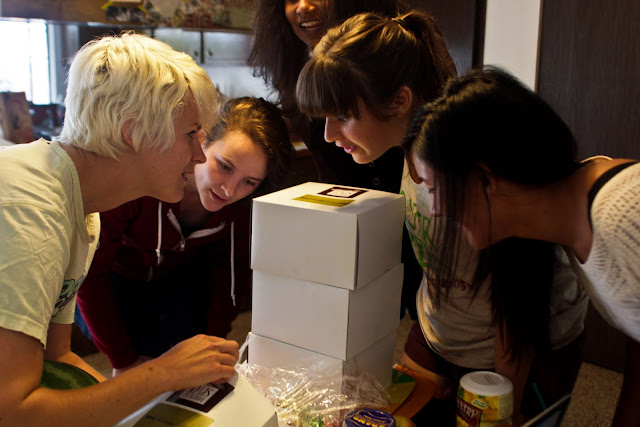
The day started separately for all of us. We split up into two groups. Naomi, Anastasia, and I (Leo) went to New Seasons Marketplace to buy refreshments and snacks for the volunteers. New Seasons was nice enough to donate a $50 giftcard to help fund our food purchases. Earlier that day, Naomi also picked up several cakes from Baker and Spice Bakery, again donated.


The others, including Shabina, Nathan, Huntley, Barbara, Kari, and Allison were busy at our secret headquarters (aka the Shrub House) assembling clipboards and other materials for the volunteers. They soon received word that more volunteers than they anticipated would be arriving: several people from the Corvallis Summer of Solutions program would be joining us!

The food group reconvened at the Shrub House to quickly prepare some food for the volunteers. We purchased chips, dips, and a variety of fruits and vegetables for the volunteers to eat in between canvass areas and rest stops.

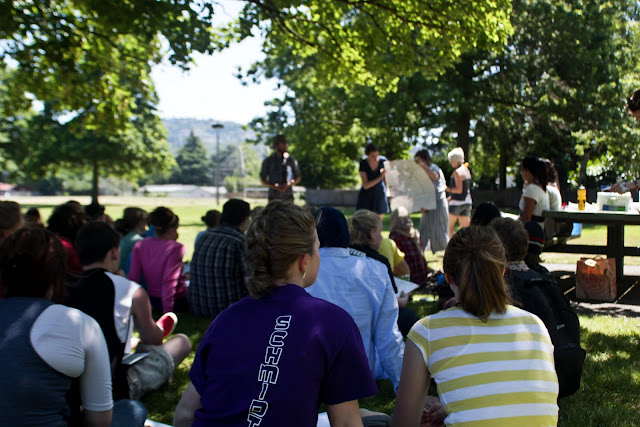
Once the volunteers from Corvallis arrived and introductions were had all around, we packed all our materials and food and moved to the park next to Kelly Elementary, where our training would be held. Shortly thereafter, about 25 volunteers from Second Stories, as well as their older interns arrived at the park.

Nathan and Allison did a thorough canvassing training for them. Many had never canvassed before and were quite nervous about the experience. We explained to them the basics of what we were doing, as well some logistics, such as our coding system and how to read the turf maps. Finally, we split into groups to practice the canvassing script and giving surveys and challenges.

Heading out with volunteers in tow, we each were assigned a block or two of houses in the Kelly Elementary area. Some volunteers were nervous, others were eager, and the whole experience went very quickly.

We ended up covering nearly all the turf that we had set out to cover, basically finishing all the turf in the Kelly School area. Many of the groups had multiple challenges and surveys. The numbers aren’t quite in yet, but we’ll keep readers updated as they roll in!

https://picasaweb.google.com/s/c/bin/slideshow.swf

So, what are you doing this summer?

A question I am often asked while running into friends, family, or meeting new people.

I used to have a really difficult time answering this question, due to the vast possibilities and powerful emotions I have associated with Summer of Solutions. I’m working with the Twin Cities team, and up until a couple weeks ago I tended to throw out phrases such as “youth leadership,” “sustainability,” “green economy,” and “it’s super cool, I promise,” with hopes of creating a semi-coherent explanation of what I am up to this summer. Depending on the audience, some people just nodded their heads in approval, having heard key words indicating it is a meaningful program. Many friends could sense my vibes of excitement and continued to ask for more information about what, specifically, I am working on.

During one of our weekly community reflection sessions a while back, I realized what I came into this program intending to work on has completely changed. I wanted to do urban agriculture work, and spend some time outside getting my hands dirty. But when the projects were announced, the one I felt I could make the most impact in completely overtook my attention, and I have been dedicating hours to this project since. I’m working on outreach in the Highland Park area, with hopes to re-invigorate the closing Ford manufacturing plant. It’s a great project that really speaks to me, having spent a significant portion of my high school years messing around in the Highland village.

Now that I’ve secured my interests for this summer, the big question for me is, “what will I be doing this fall?” I still have some of time to figure this one out, but it will definitely involve implementing many of the tactics I have learned this summer. I hope I will be able to educate my peers at school and pass on the passion I feel towards this work. I’m really grateful for going with my gut instincts in this program & following where my passion leads me. I have spent much of my SoS work with a smile on my face, which is a great thing to look back on as I reflect on my summer.

My Work

When I journal or write things that are only meant for me to write, I often use this term called ‘my work.’  I don’t mean my job, like the thing that makes me money. I don’t mean checking things off of my to-do list. I mean the ‘work’ that when I say it, sends tingles down my spine and makes my heart smile. It’s the work of joining with millions of other people, some of whom I know, some of whom I will never meet, to collectively heal our world.

The distinctive thing about ‘my work,’ and the thing that makes me feel so good when I say it, is that it really is work. It’s slow, and incremental, and not always glamorous or even visible. It’s copy and pasting data into a spreadsheet for hours late into the night, and knocking on doors in the blazing heat, and making dozens of phone calls inviting people to community meetings.  It’s spending  a week to prepare a two-hour anti-oppression workshop, and spending six weeks to organize a two- hour community energy forum, and spending seven months to plan an eight-week summer program, simply trusting that each will have an impact to justify all that time.

This ‘work’ is so powerful because it is a true expression of deep love for the world, and hope for the future. I was introduced to this concept at a summer camp where I worked two years ago, where the phrase “Work is love made visible” was often thrown around. However, it was not until Summer of Solutions that I fully understood what this means.  My work with Summer of Solutions helped me fully embody the idea that to work in developing the green economy is not just about getting things done, but also about continuously enacting our loving the world.

This concept is expressed beautifully by the poet Kahlil Gibran, who writes:

“Always you have been told that work is a curse and labour a misfortune.
But I say to you that when you work you fulfill a part of earth’s furthest dream, assigned to you when that dream was born,
And in keeping yourself with labour you are in truth loving life,
And to love life through labour is to be intimate with life’s inmost secret.”

This other important thing about ‘my work’ is that it really is mine. As Gibran puts it, the work that we do was assigned to us when the Earth’s dream that we are fulfilling was born.  ‘My work’ is beyond my choice. It seems too integral to my being to be something I could ever get disillusioned about.

My goal as I leave Summer of Solutions and begin a year of launching a brand new program (New York City- it’s on!) is to carry my passion for ‘my work’ into all my interactions. My hope is that I can engage new people in this movement by fully demonstrating that this work makes me feel fulfilled and happy and grounded, not just when I win or succeed, but just because I’m doing ‘my work.’

Elana Bulman- Twin Cities Program Leader

Growing by Doing

Kyle Gename

Throughout my time as a student at Macalester College, I have always thought of myself as an environmentalist. For my first year there, I practiced and explored my philosophy on the environment and resource use in a very personal way. I became and avid knitter, an Environmental Studies major, and to the dismay of my freshman roommate, a person who showered infrequently.

In my sophomore year, I wanted to get involved in a more collaborative way. I began to think, “I certainly cannot create real change without the support and action of my peers, why go at this alone?” I decided to get involved in my school’s student environmental group, the Macalester Conservation and Renewable Energy Society, or MacCARES. I also started working in the sustainability student worker network and went to Powershift, a national conference geared towards young adults interested in creating change through grassroots activism. Throughout my two years of exploring my environmentalism at Macalester, my ideas of what I wanted to do and be were changing.

After sophomore year, I decided that rather than go home and read through the Harry Potter series for the tenth time, I wanted to find more useful work. I kept my eyes and ears open to the opportunities available to me. Through MacCARES, the student group that I had joined, I met two of the program leaders for Summer of Solutions Twin Cities, as well as several of the programs’ past participants. Through their encouragement and rave reviews of the program, I decided to apply. It sounded like an amazing program, and one that would help me to develop further as an environmentalist.

When I decided to become a participant of Summer of Solutions, it was based on conversations that I had with people who were already involved in the program. They said that SoS had shaped them; it was a place for them to grow. When I asked what they liked about the program, they told me that participating was a formative experience in their lives as young leaders and that by stepping out of their comfort zones during their work, they were able to become more well-rounded. I am happy to say that these reviews have been on par with my own experience this summer.

Throughout my time in the program, I learned something that I had forgotten about myself: how I grow and develop as an individual. This summer I remembered that I reflect best on the work that I have done using few words and simply recollecting the new skills that I have learned. This is how I have stepped out of my comfort zone this summer, not by talking or explaining, but by doing something new. By doing, I have grown stronger as a young leader and an environmentalist.

Since we spend so much time as a collective group talking about how we are feeling and discussing what we are doing, I find it strange that the times that I most cherish when working for SoS are the times that I am not saying anything at all. My experience is defined by what I do physically and the personal reflection of what I am doing. I have grown much more as an individual this summer when I have thrown myself out of my comfort zone and done something that I normally would not. If you told me two months ago that I would be taking notes in small group meetings and be responsible for accurately reporting those notes, I would have told you that you were mistaken. I am God-awful at typing, and have just recently learned to type without looking at the keyboard. I have also never blogged before (Am I doing a good job?) and am terribly afraid of what other people think of my writing. Beyond participating in new ways during small group sessions, I have also stepped out of my spatial comfort zone. I have never had a sense of direction or the inclination to exercise very much, but this summer I decided that my bicycle would be my primary mode of transportation. I am pretty excited to say that I have never learned more about different streets or bike routes than I have this summer. The moral of the story is that SoS has been a formative experience for me in the way that it has challenged me to act in ways that, until very recently, I did not think that I could. It has also made me realize that I find physical labor and action more memorable and significant than just talking and listening.

Even though many of the hours that I work for SoS for the next two weeks will be spent discussing my feelings with the other participants, I am excited for the growth that I can realize this summer not by talking, but by doing. I am also glad that I have been able to reflect on these ideas for long enough to understand them. Here’s to spending the rest of my time as a SoS participant growing by doing.

A “Kiss and Make Up” Justice System

This week, the climate activist Tim DeChristopher was sentenced to two years in prison for standing up against oil companies and defending our future.  During this historic moment of great courage, I’m reminded how our justice system is inherently flawed, and imaginging new possible futures that include more kissing.

You would never hear a judge say, “I sentence you both to kiss and make up.” A little silly, yes. Almost as ridiculous as our current system of mass incarceration.

When a hero is behind bars, a murderer walks free, and our prisons hold more black men than slavery ever did, it’s time to ask what’s underlying the statistics, and imagine new possible futures.   The Smooch project (a winner of the Possible Futures film contest) is doing just that — gathering photos of people sharing affection, capturing some powerful stories, and imainging a future where a mother chooses to forgive her son’s killer.

When I think about a new possible justice system, I think about how much I love living a city with such a energetic spirit of social justice. A friend of mine, who owns a green business in Oakland, once compared Oakland to Paris.  Although we don’t have the Seine, we do have Lake Merritt and a lot of geese. I love how Oaklanders walk and bike everywhere, there’s a “take to the streets” energy, the climate is almost always 70 degrees, and people hang out at hipster cafes drinking coffee in the sunshine.

I was recently biking up 35th Ave, right near Fruitvale BART station where Oscar Grant was shot. As I headed to our Summer of Solutions Oakland planning meeting, I was in awe — beautiful, purple, hanging flowers had bloomed on all the trees lining the road.  In the midst of delicious smells coming from the Pupuserias, little dogs barking behind fences, and store windows that still display photos of Oscar Grant, I saw the beauty that is only Fruitvale.

Reading all the blog posts about Tim’s sentencing reminds me that our criminal justice system is immensely flawed, and we need to change it.  We need systems that address root causes of violence, not lock away black and brown children. We need to honor heroes who stand up for our future, not put them behind bars.  We need to acknowledge how imbedded issues of race, class, and power are in our current justice system, and work towards a system of Restorative Justice. (I can only imagine what Tim’s sentencing would have looked like if we were using systems of restorative justice, not a system owned by corporations.)

Finally, we need to imagine a new possible future for our justice system and our world. Hopefully, one that includes more kissing.


For information and insights on the state of our prison system, check out Michelle Alexander’s book, The New Jim Crow: Mass Incarceration in the Age of Colorblindness.

*Cross posted from: We Are Power Shift blog

Arable Land to Aquaponics: Urban Farming in the Twin Cities

By Kalpana Vallabhaneni

During World War II, 20 million Americans planted “victory gardens” and they grew 40% of this nation’s produce supply. Urban farming is something that has been around for decades and has already proven itself. It can support America, so why not prove it again to people who don’t believe us? Urban Farming is not only used to create an abundance of food for people in need by planting gardens on unused land and space in the city, but it is also used to cut down on crime, beautify neighborhoods, and increase health and wellness around specific community.

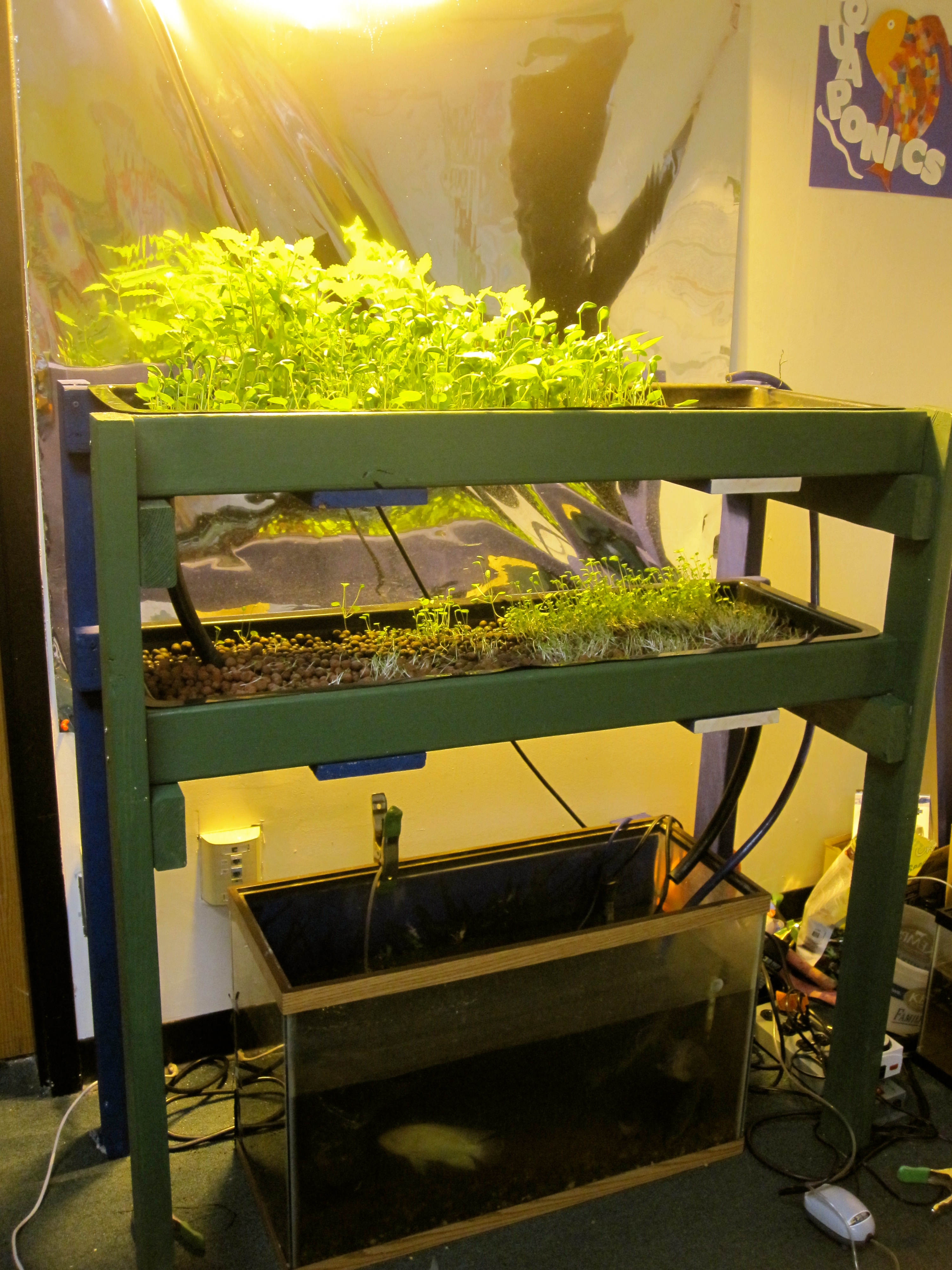
Participants in Summer of Solutions in the Twin Cities have been working long and hard on a variety of projects ranging from maintaining an aquaponics system to weeding gardens to researching the cities vacant lots to find arable land for new urban farms.  With over 20 participants focusing their energy and effort into specific projects there has been a lot of success all over the cities.

Many people assume that urban farming is planting vegetables, fruits, and herbs in open spaces in a city and it is, but urban farming can be so much more! A small group has been working on a urban chicken coop! They have been researching various locations, chickens, and a design so they can build the best coop in town. Thus far in the summer they have located a space in Minneapolis and are starting to build the coop this week. They are still trying to figure out which chickens are the best–in terms of the care they require and the number of eggs they lay. After talking to some locals who already have chicken coops and using their best tool, the internet, they will determine which chickens to put into this handmade chicken coop in Minneapolis.

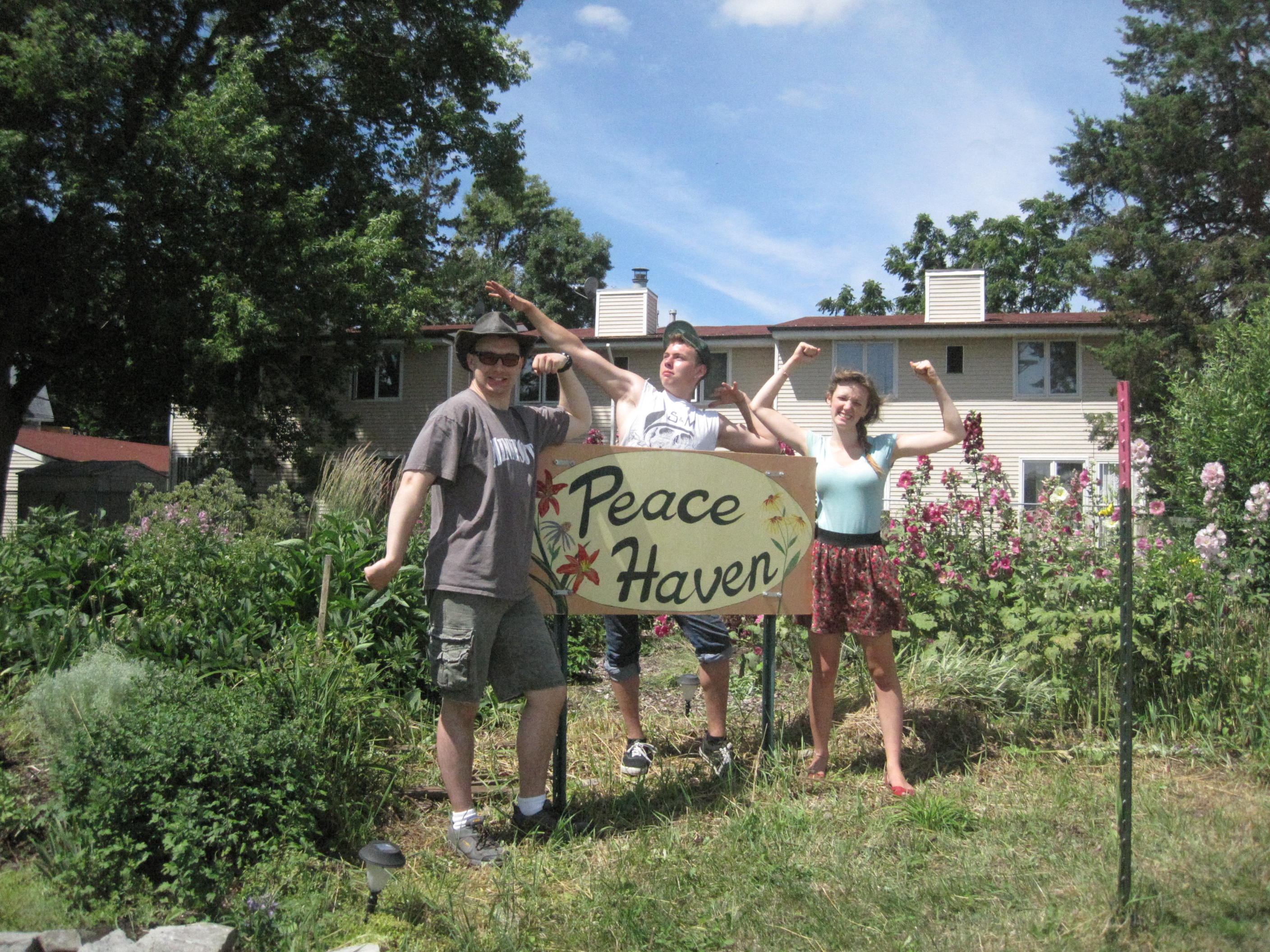
Another group of participants are focusing their energy into generating their value through crime prevention at the Harrison Neighborhood Association Peace Garden.

Look at all the muscle we bring the the garden!

This farm was started to help stop violence, prostitution, and drug trafficking. The simple tasks of weeding and beautifying this farm has helped keep this previous prostitution corner a safe, healthy, and beautiful street corner for community members to enjoy and cherish. With a small but powerful group, they are able to help keep the Harrison Neighborhood Association Peace Garden be a safer and happier place.

We not only generate value for the community through Urban Farming but many of us are gaining personal value through farmer trainings, beautification, and researching vacant arable lots around the cities. There is a group of participants who are interested in the physical processes of Urban Farming.

Look at that broken piano part that is now a beautiful sign for the garden!

Concrete Beet has multiple young Urban Farmers who  started urban farms recently by taking a vacant lot. They worked out logistical details with the landowner and covered the entire lot with a garden. Now they are helping participants learn the ins and outs of CSA (Community Supported Agriculture) shares and the physical labor or harvesting, planting, and planning. A few participants are also researching the cities vacant lots to see if empty lots could be turned into new urban farms. They research the price, location, and soil quality, because farmers needs arable land for a garden to be successful. There is another group who is helping with the beautification of the farms. Most recently they have rescued a broken piano and hand painted beautiful signs on the old, damaged piano pieces. These signs are displayed around various parts of the garden.

The last Urban Agriculture project that participants from the Twin Cities are working on is with a 5O1C3 non-profit, YEA (Youth Enterprising Agents) Corps. There are about 15 YEA Corps participants who are working as interns at YEA Corps who are each focusing on different aspects of indoor urban farming. YEA Corps is working to empower youth with job skills and sustainable education. YEA Corps is not the typical urban farming project to many people but it still focuses on sustainable food production in an urban setting. Their current focus is on mushrooms, aquaponics, and vermacomposting. Each intern has a different aspect that he or she is focusing on ranging from being a mushroom specialist to learning how to treat the vermacompost. Some of the interns are working on research while others are filming videos for YEA Corps. There is a wide variety of job skills and indoor urban farming expertise that are being learned everyday at YEA Corps.

So far this summer we have accomplished a lot all over Minneapolis and we look forward to seeing how much more we can do! We are all gaining valuable skills and knowledge by helping the community around us!

Rise Up with the ARISE Coalition

By: Taleya Hamilton

A soccer mom suggesting more soccer fields for her children…

A young professional couple raising the concern of property value if a light rail system is installed next to their house…

These and many other local community concerns have been raised and addressed through the public meeting hosted by the ARISE/Summer of Solutions Team. ARISE (which stands for Alliance To Re-Industrialize For A Sustainable Economy) is a coalition of community residents, students, labor union and city leaders who have come together to create sustainable solutions to local redevelopment projects in their communities. Green manufacturing and multi-use development are the anchors to ARISE’s vision; however, clean energy, mass transit opportunities, and localization of basic services (i.e. waste management, food production, etc.) are significant players in formulating the sustainable solutions for job growth and a diverse tax base. One clear message ARISE wants to convey is that everyone from the soccer mom to the young professional couple can have a voice in the development of their community.

The Summer of Solutions team has been working diligently and progressively with ARISE throughout the summer to carry their message forward. Through the guidance of Lynn Hinkle (the ARISE visionary), participants have engaged in the various components of the vision, which include research for the universal template that is being created to promote ARISE in local communities, recruitment of land developers, and community outreach.
Currently, ARISE coalition and the Summer of Solutions team has centralized their efforts on a 135 acre site used by the Ford Motor Company in the Highland Park area of St. Paul, Minnesota. This site, established in 1924, has been an assembly plant producing the Ford Ranger. As the Ford Ranger sales significantly slumped in the past years, Ford Motor Company has decided to close the doors to its St. Paul location as soon as December 2011. This decision has sent St. Paul city planners and the Highland Park residents reeling for answers to mitigate the economic impact. Hundreds of workers will be laid off and a community that was built around the Ford Motor assembly plant will need to find a new local economic driver.

ARISE has recognized this concern of the area stakeholders as well as analyzed the valuable features of the land (i.e. the hydropower plant nearby and sand mine tunnels underneath the site) in order to develop renewable energy scenarios that will allow for the community to be self-sustaining in the next planning efforts devised. For example, ARISE is looking into converting the sand mine tunnels into ground source heating for the site as well as affordable housing options for the green manufacturing plant employees and their families.

ARISE coalition is an ongoing initiative that will continue after the summer months have passed. If you or anyone you know are interested in spreading the message of our work and providing additional expertise in the subject matters highlighted, please contact us 708-274-7344 or mn.arise@gmail.com. Also, visit our website at http://www.arisemn.org.