The Answer is Blowing in the Wind


See car on the road for scale

Last Sunday afternoon my day was rudely interrupted when the power went out. It was off for less than three hours but for that time I felt completely incapacitated, disconnected from the rest of the world and lost, not being able to do anything productive. Though logically I knew it was true these three hours demonstrated, more then all of the facts and figures I have learned, just how dependent we are on power to function on a most basic level.

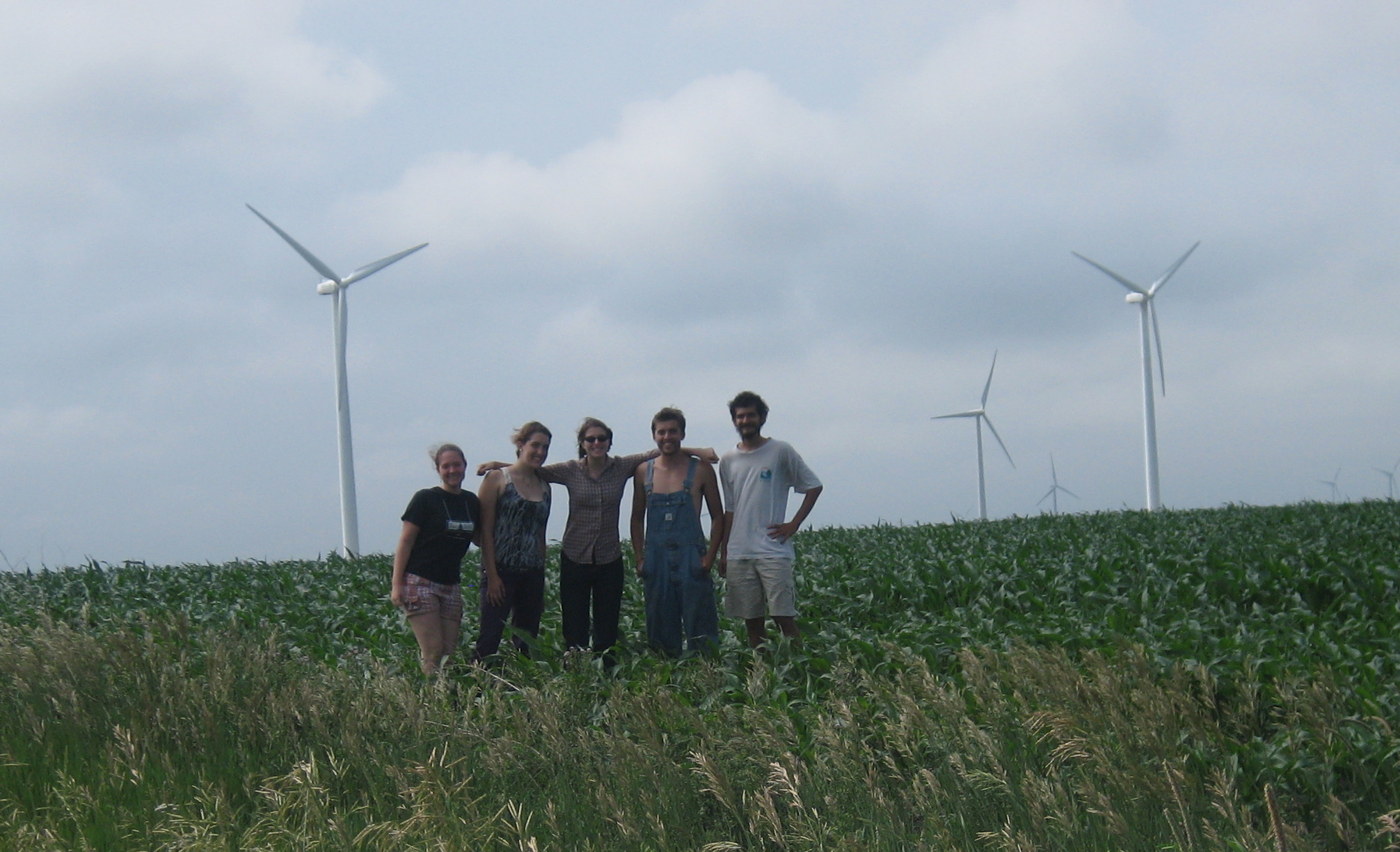
This realization was quite timely, just after our visit to rural, Western Minnesota and one of the largest wind farming areas in the country. Minnesota is leading the country in wind power. Driving by farms of corn and beans we could see hundreds of wind turbines all around, it almost seemed like the cute baby .75MWs were slowly growing into larger adult 1.5MW turbines as we continued down the road. While impressive from a distance I was not prepared for the sheer magnitude of a wind turbine up close.

Continue reading

“If we don’t do it, who will?”

That’s the question we asked earlier this week when discussing who should research possible alternatives to the high-voltage transmission line slated to cut through the neighborhood we work in.

Transmission lines are necessary, you may say. For the most part I agree. There have been a few brown-outs in South Minneapolis, and the utility claims there is a significant shortage. (Although no independent studies have confirmed this) It’s true: we need to get energy from where it’s captured to where it’s needed.

What I’m thinking about this summer is: What if neighborhoods could produce, consume and manage their own energy, and grow to be independent of private and public utilities who often ignore their needs and experiences? There has has been little to no consultation of the people who live in this mid- to low-income, diverse neighborhood.

Why aren’t new highways, transmission lines, railways,  power plants planned in Mac Groveland? Northwest Portland? Why are they in South Minneapolis, in Vanport? I won’t go too far into the environmental justice implications here.


An example of high-voltage transmission lines

Some of us attended a meeting about the possible alternatives that included state representatives, non-profits, state university researchers, community groups etc. At the end of the day, none of the well-established entities would accept the task to research alternatives. The funding has been unalotted for the research, and no one will accept the project A) because there is no money for it, and B) pitting oneself against one of the largest private utilities is (“potentially”) political suicide.

Who better to take on the project than a bunch of enthusiastic, naive college students? Exactly.

In this case, (and perhaps others too) youth is an asset. Keep you posted.

The next step for environmental justice.

I love eating fresh veggies and fruits when I know where they grew and who grew them.  There is a large assortment of photos of me at various ages crouched in a strawberry field with my hands and face stained red.  I’ve got some tomatoes and peppers and herbs going in the backyard here.

So it might be disconcerting to hear I’ve felt a lot of resentment for the local food movement.  As the “eat local” push was gaining momentum the enormity of climate change was consuming me.  The local food movement I experienced up to this summer was mostly white, relatively privileged and, as I perceived it, somewhat self-indulgent.  Modern agriculture isn’t the only root of climate change, so why pour all your effort into an alternative only a few people can afford?

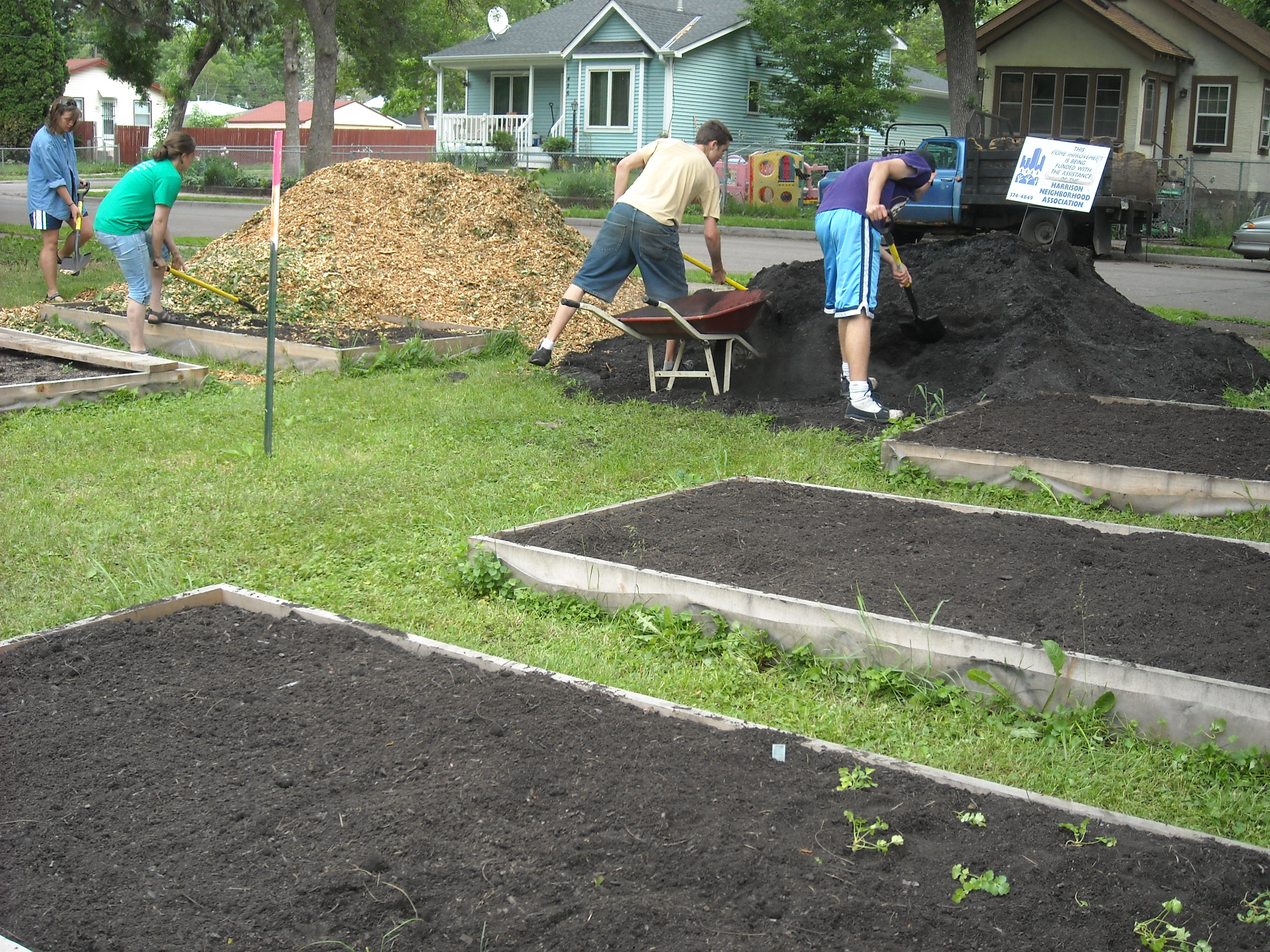
I got off the phone last night with Annie Young, an Environmental Justice (EJ) organizer for the Harrison Neighborhood Association (HNA).  I had written the start of this post and then taken a break for dinner when she called.  While my opinions on local food have evolved significantly in my weeks here, that conversation with Annie put the last nail in the coffin of my previous views.

Planting in Process on Logan Ave


Continue reading

Have the alternatives been exhausted? (After being exhaustively explored?)

Xcel Energy has one reasonable rationale for their proposed high-voltage power line through South Minneapolis, specifically the Phillips neighborhood, near Lake Street, at first glance: there has been growth, especially in institutions such as hospitals that use large amounts of energy and indisputably require reliable energy. Blackouts in hospitals are obviously a bad thing.

However, is putting through a new power line that’s just a continuation of the current energy-production regime the only option to provide reliable energy? In the face of climate change and fossil fuel depletion and economic challenges, is that the best system to perpetuate? What about being able to use less energy through efficiency measures, many of which are relatively easy, inexpensive and can be done by the large organizations as well as by individual households all around the area? What if there were a few solar panels on homes and small businesses? These options aren’t impossible, are they?

This might not provide all of the community’s energy, but could it possibly be a method in which the energy demand gap could be made up – and provide a basis so that more of the community’s energy could be produced in such manners in the future? Could it engage the community in working individually and collectively on their own energy? Are families,panaderias, groceries, hospitals, banks, churches, mosques, YWCAs and Scandinavian gift shops limited to being consumers of energy, disconnected from its mysterious production? Or, could they be a part of taking ownership of even a small part of what daily powers their homes and places of business, recreation and worship?

More fundamentally, what are the details of the increase in energy usage? What do the various individuals and organizations in the community think about their energy usage? Are some of them already employing energy efficiency materials? Is there any hidden interest in more energy efficiency and renewables that just haven’t found the opportunity to manifest itself? Could this be that opportunity?

Essentially, do we really know if the new power line is necessary if all these questions haven’t been answered? Can we find answers to a lot of these questions? What might those answers tell us about the necessity of the transmission line?

TOGETHER WE RISE

For the past few days, my younger brother has been reading a book for school called The Fate of the Earth. If the title weren’t depressing enough, the book primarily consists of an account of the hysteria over the rise of nuclear arms, the resulting existentialism, and what those arms mean for…well, The Fate of the Earth. Supposedly, with the development of these weapons in the 1940s, humans officially became the first species in history with the potential to devastate not only our own population, but every other species, and quite literally the entire planet. Even today, nuclear annihilation is on the world’s mind as the greatest potential manmade disaster.

The truth is that humankind developed destructive potential long before the rise of nuclear arms, and the greatest threat to our extinction today is not a nuclear threat, but an ecological and environmental one. We are the only species that is knowingly and voluntarily causing its own demise…literally. Okay, so I know we all know the story. Everyone and their mother has seen An Inconvenient Truth, heard politicians use catchphrases like “green energy” and “sustainability,” and thrown things at Glenn Beck. But too many of us, like me, are used to sitting on our butts at home, preaching from a high horse about turning the tap off while brushing our teeth.

The most difficult part of “environmentalism,” from my point of view, anyway, is internalizing it. Learning to see it as a movement that is not foreign or outside of oneself is difficult. When we watch the news, we are passive creatures, mentally absorbing oil spills, holes in the ozone, floating piles of garbage by the Great Barrier Reef, and distancing ourselves from them. But when we encounter those things up close and personal, and when we can physically see the differences our personal choices make, we realize how big and important this whole thing is. And it becomes most evident on a local/community level. I know it all sounds cliché, but it’s true.  And that is why I have decided to spend my summer in Highland Park, Michigan as part of the Green Economy Leadership Training.

Continue reading

In an Entrepreneurial State of Mind

I’ve always had a lot of hobbies, and loved learning new skills. Knitting, spinning, gardening, biking, journal-making you name it. But they were always just that: hobbies. The world I grew up in told me I could have as many hobbies as I want, but at some point you get a career. Most likely in an office. Most likely in front of a computer.

And because ever since seventh grade when I stood up for monarch butterflies in a science class discussion of GMOs I have been labeled as a do-gooder and environmentalist, I sort of imagined my fate in the office of a non-profit, getting paid meager wages to do tasks I cared about theoretically. Recently I have felt that because I have no idea what the world will be like in three years, I can’t really know what I’ll be doing. While I still believe this, Summer of Solutions is opening my eyes to the potential to make a job out of the things I love.

One of my favorite organizations of all time is Books for America in DC, where I volunteered for awhile and now always make a point to stop by when I’m in town. It was started by a guy who collected books in his apartment to donate to schools, shelters and prisons. His collection grew so large he started an organization out of it, which now has a warehouse of books that teachers and others can choose from. All the books that can’t be donated are sold in the store in Dupont Circle at bottom dollar. The proceeds are donated to the same institutions that get the books. So it’s a non-profit that consistently makes money. The recession year of 2009? Biggest profit margin ever. Why is this so revolutionary?
(http://www.booksforamerica.org/)

The non-profit sector has been at it for a while, but something’s not working. Not for our schools, our health, our natural world or our workers. Relying on grants and donations to fund “good work” only gets us so far. If we’re trying to change the system that created these problems why remove ourselves from competition with it? Innovation drives change. Books for America can compete as a bookstore while sustaining its charitable mission. That changes the rules of the game, instead of operating in the margins.

So what am I going to innovate?

I spend a lot of time thinking about waste and overconsumption in America. The amount of stuff that’s sitting out there in someone’s basement or attic or garage. Books, bicycles, lampshades, birdcages, futons. The fossil fuels poured into all this stuff. And then the number of people who wake up in the morning needing something desperately. How do we bridge that gap? How, like Books for America, do you turn that exchange into something more than charity, into something mutually beneficial?

Books for America. 22nd and P if you find yourself in DC.

Majora Carter + Summer of Solutions = Awesome

Isn’t it great when you get to meet someone you really admire, and she turns out to be just as intelligent, interesting, and just darn nice as you had always hoped? That was my experience at Majora Carter’s Green The Ghetto event in North Minneapolis. The event was put on by Matt Entenza’s campaign for governor. Majora even took a picture with those of us who’d come from the Twin Cities Summer of Solutions program:

Look how happy we are!

Solutionaries with Majora Carter

Continue reading

I want to ride my bicycle.

Earlier in June, I took the 21 bus along with four others to University in St Paul and then caught the 16 headed east. We arrived at Sibley Bike Depot, tucked in a strip mall past the “Sugar Rush” donut shop. Chocolate and sugar wafts down the hall into the bike shop. Inside the walls are lined with drawers of varying heights and sizes with bike parts and tools hanging above. The shop floor has several bike stands to work on and tools. There are also bikes for sale on display- Schwinns and Huffys and Raleighs and more.

We got a peek into the bike storage room which is usually locked up. A pile of bikes at least a dozen feet high and 30 feet long dominates the room. The bikes are layered one on top of the other; handle bars jammed into back wheels and seats knocking into pedals. All of them are donations.

Signboard at Sibley

Sibley Bike Depot is a non-profit community bike shop that Summer of Solutions is partnering with. It has gone through several incarnations as an organization, one of them being the Yellow Bike Collective, which inspired the Yellow Bikes of Hampshire College (where I go and occasionally have a go on a Yellow Bike). Recognizing how many opportunities bikes open up, Sibley’s current mission is to increase bike access in the Twin Cities. People donate bikes to Sibley, then volunteers and staff fix them up for sale. People who come into the shop and work on a bike can earn it to keep.
Continue reading