Greetings from Omaha!

From May 26-28, solutionaries from St. Paul, St. Louis and Omaha gathered in Omaha to discuss the Midwestern Summer of Solutions programs just weeks before they started. At the gathering, we brainstormed safe space ideas as well as goals for SOS. We then discussed ways of defining what it means to be a solutionary and ways of orienting new solutionaries to our programs.

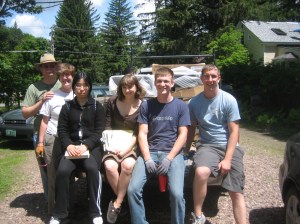
Timothy, Tyler, Lance, Melissa, Connor and Aaron at the Omaha gathering

Timothy, Tyler, Lance, Melissa, Connor and Aaron at the Omaha gathering

Much of the rest of the time was spent planning how to ensure successful communication occurs within our teams, between teams, and with the broader climate movement, as well as how we can make Summer of Solutions and Grand Aspirations grow ever-larger while maintaining sustainable sources of funding. We also had time to relax and get to know one another better, including a hike in the nearby Loess Hills of Western Iowa.

Summer of Solutions had a bit of a slow start here in Omaha, partly because some of us were not in Omaha before summer began. We also had challenges with communications and research because we do not have internet in our house. This changed a few weeks ago, however, when we got a new office space near our house. In recent weeks we have begun to get involved with a few large projects.

Continue reading

Courageous climate-saving superheros?

Last Wednesday night, a group of about 15 Worcester Solutionaries sat around a community fire hosted by our local librarian, advisor, and spiritual teacher Rachael Shea, checking-in for the week after one of our delicious, abundant potlucks. Rachael and her fellow friend, shaman, and healer Dan Sprinkles, who was a special guest visiting us, posed the questions, “What motivates you to do this work for Summer of Solutions?” “What brings you together as a community in ways that seem so natural to you but yet take time and practice from so many others?” and “What gives you the courage to do what you’re doing?”, not necessarily expecting an answer, but just hoping to understand how and why we’re doing what we’re doing this summer. The last question struck me as particularly interesting and maybe misdirected because I did not consider what we were doing “courageous” per se; to me that sounded too gratifying or pedestal-deserving than what we were actually doing. After talking to Dan about it more and asking what he meant by that question, he told me that “courage” actually comes from root definitions meaning “action from the heart”. All of a sudden it made more sense to me, and I do see our work this summer as full of courage; not in a medal-deserving way, but in a way that we maybe don’t know exactly why we’re doing what we’re doing, but it feels right, important, and coming from a natural pull from our hearts to action.
IMG_7832

Weatherizing homes and the potential of skill

Here in the Twin Cities, one of our projects is Cooperative Energy Futures, a cooperative harnessing the power of efficiency to build community as well as energy solutions. We sell a lot of materials for home weatherization, but many of us had never tried these materials out. To educate ourselves more about how home weatherization is done, we enlisted the help of Jim Walsh, one of the founders of Project Warm in Kentucky. Last Saturday, about seven solutionaries did a walk-through of a house owned by Macalester College. Jim told us about different kinds of heat loss in a home and explained how to combat them. We mostly focused on convective heat loss (the kind that happens through the loss of warm air) rather than conductive heat loss (the kind that happens as heat moves through solid surfaces like walls). Armed with new knowledge, we walked through the house and he showed us where to look for inefficiencies.

Unfortunately for us (although fortunately for the residents), the house was already very well weatherized and there wasn’t very much for us to do. There was one window that needed weatherstripping, a door sweep to replace on the front door, some caulking to do in the basement, and a whole bunch of window pulleys to make more airtight. All of these are methods to plug up small holes in outer walls that let either cold air come in or warm air escape. We went back today to install them. They’re all fairly cheap methods — where the cost in weatherization lies, Jim told us, is in the labor.

That’s one thing that has really stuck with me, the idea that there’s so much value to add to weatherizing materials by knowing how to use them. I’ve been thinking today about the possibilities for CEF if we were really good at weatherizing. We’re already working on a workshop to teach people how to use caulk and weather stripping. As I understand it, one of the major flaws in energy auditing as it is done now is that the auditing work is separate from the installation of the needed materials. What if folks from CEF came around, did audits, and installed needed materials? I know this idea isn’t new or unique, but it really hit home for me today while I was actually installing pulley covers and caulking windows. I am really excited to figure out how we can simplify the process of making people’s homes more efficient and use it to do the parts of CEF that ARE new and unique: building communities that are empowered to create their own energy solutions.

Looking into the Future: A Fireside Chat with Timothy and Matt

Over the past two weeks, I’ve gotten particularly excited about looking ahead to where we’re going. My eyes are always both here in now and endlessly on horizons. The past few weeks for me have been about thinking bigger about where we’re going, and about exploring how to share this moment of possibility with everyone …

Fellow national coordinator Matt Kazinka and I pulled together this firesdie chat on Thursday night with the help of camera-woman Abbie Plouff and editor Ruby Levine. Its basically an explanation of some of the things going on in the bigger national picture and an invitation to start the process of dreaming with us as we go forward.

Part 1: Welcome, what’s up, and why we’re talking:

Part 2: The big things happening, and next steps on collaboration:

We’ll be checking in, first with Summer of Solutions program planners, and then with partners, participants, and other supporters over the coming weeks.

Keep up the solutions!

Growing Up!

Austin Werth, Carl Skarbek, Robin Major, Kate Murdock, Melinda Vogel

Austin Werth, Carl Skarbek, Robin Major, Kate Murdock, Melinda Vogel

I joined the Summer of Solutions because I needed an excuse to stay in the Twin Cities for the summer, instead of at home in Kansas, and I wanted to have something to do in case jobs didn’t work out (and they haven’t! ☹).  After thinking more about it, though, I realized how much I actually wanted and needed to learn about the Green Movement and environmentalism and sustainability.  I’ve supported the movement for some time now, but I didn’t really know the issues or the arguments.  Since starting the summer, I’ve met some really great people and noticed that just my involvement and participation in the program has, in itself, been a big step for me, taking me outside of my comfort zone, and I know it will really help me to pursue things in the future that I might normally have shied away from.

I’ve really embraced the Good Neighbor Gardens sector of the Twin Cities program, working to install vegetable gardens on private plots throughout the community, allowing the owner of the yard to keep many of the vegetables and herbs for their own use and donating some to a local food shelf.  After some initial setbacks, we’ve refocused Good Neighbor Gardens 2009 to be a summer of self- and group-education, to become experts in urban agriculture to really be able to sell our vision in summers to come.  We have two different donation plots, one in St. Paul and one in Minneapolis, in which the owners basically had extra space in their yards and are allowing us to use that space for free.  We just planted another garden in St. Paul at the Rezek House, a part of Lutheran Social Services, which houses twelve 16-21 year olds.  The Rezek House will actually be using the food that grows in their garden, which is really exciting for us to see!  The other two gardens can be a bit more experimental, but it’s so cool to know that the plants that will grow (hopefully!) in the Rezek garden will be feeding the actual people that live there!  We planted some seeds and transplanted some seedlings and things are starting to grow.

Continue reading

Trek to Re-Energize America

Last night, a bunch of us from Summer of Solutions met up with folks from the Will Steger Foundation and the Trek to ReEnergize America.  The Trek is a bike trip of riders from around the country who are traveling from Seattle, WA to Washington, DC to bring attention to the need for strong action on climate change and energy security.

The approach that these riders are taking turns out to be extremely similar to the outcome of a recent SoS workshop that Timothy led on community organizing.  We have all come to the conclusion that the most vital aspect of organizing is this: to listen.  The riders aren’t going into communities spreading fear about “global warming”, because for most Americans, there is already enough to worry about these days.  Instead, we benefit more from listening to the concerns within a community and the actions that communities are already taking to address the concerns they have.  Perhaps not surprisingly, our end goals are fairly similar — we all want to lower our energy costs, ensure that we (and our neighbors) have family-supporting careers, and thrive in communities that are healthy and connected.  Talking less and listening more is a strategy we are all striving for.

I realized how much the Trek is something I would love to be a part of.  While I can’t change my summer plans at this point, I am going to bike with the Trek today, along with some other SoS folks, to Stillwater, MN, where we will enjoy a folk concert, and before back to the Twin Cities (~50 miles round trip). I can’t wait to hear more stories from the Trek (and make a few of our own) along the way.

http://trektoreenergize.org/blog/

IMG_8761Above from right to left: Tom Tailer, Beth Tailer, Wanling Su, Courtney Devoid, Mitchell Dumond, and Kris Bartell. We were getting ready to deliver stoves to 3 families. We spent the day hauling stoves up stairs and talking with the families. Pellet stoves are a clean, safe alternative to kerosene and propane. Pellets are made out of biomass such as grass, which can be grown locally and are part of the short carbon cycle.IMG_8765
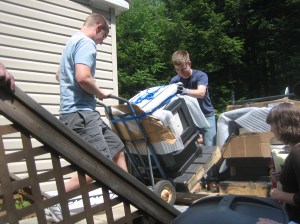
Right: Kris and Mitch deliver their first stove.

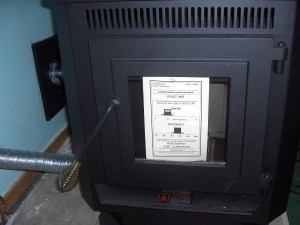
031One of the two types of stoves that have been installed.

Progress is a beautiful thing

It’s easy to get frustrated when trying to make big things happen without seeing any immediate results. The long-term goals that we are trying to tackle as members of Summer of Solutions take many small steps to achieve. Sometimes when I am sitting in a meeting, discussing a minuscule detail of the overall picture, I can start to feel extremely pessimistic. I start to think there are so many small steps that need to be completed before we can even start to see a glimmer of our desired end result.

For example, I have been working on Cooperative Energy Futures where there are TONS of small tasks to get done, a completely daunting list to look at. Really, I have to give props to the leaders of this group (Ruby, Timothy, Jason, and Austin) for making sure that they covered every last thing that needs to be done for this project in order to be a success. We have community outreach, website design, grant writing, background research, and much more to get done. The end goal is to get communities organizing their neighbors to make energy efficient improvements to their homes. When you hear the end goal, one would think that this simply involves going up to people’s houses, giving them an LED light and a 5 minute talk about energy efficiency. But, oh no, it is much more involved than that. And it should be, because this project will do amazing things.

Continue reading

Solutions for yourself

This weekend I took some time to do some real thinking about my involvement in SoS, and the reasons behind it. This was the first time I had done this in a critical manner.  In the beginning SoS made a lot of sense in a very linear way. I could spend a summer doing my own garden project, gain friends, fight famine, and have enough fortune to live on. The realities of finishing school and frisbee and african music, buying seeds and growing plants, writing organizing emails, keeping up with a thousand new opportunities and directions to go in, working close to 40 hours a week, and making a new spot in my minnesota life for my new york compatriots, have all found a way into the mix. Now there is a mess and I feel like it’s my fault for not managing my time and commitments better.

Where do I go from here?- I’m stuck in this mess. I feel like quitting summer of solutions all together because my project vision has failed so far mostly because there hasn’t been enough input from all the smart people who want to work with me, not for me as I had perhaps made it seem. I’m no longer giving it the attention that it needs and deserves. On the other hand, there’s a bunch of people now working full time on these projects and I feel a groundswell of support.

Now it’s raining and the ground can’t freeze anymore, the ground calls to the plants who are wilting in the weight without a large enough root system to stand upright. There’s a jumpstart meeting tuesday and I have many welcoming yards with some spots to spread some love around through giving living things. It’s my second day off in a row tomorrow which gives me uninterrupted time to get some things and more thinking done. I have friends, funds, frisbee, forthcoming flora, but no F harmonica I lost it at a music festival. Doesn’t mean I can’t still get Funky.