A summer program by any other name

Roughly 30 months ago, some friends and I were talking about a summer program we wanted to create. We had been spending a lot of time on a few really cool projects that focused on energy-efficiency and green manufacturing, and we thought it would be really powerful to tie our initiatives together. We figured we could raise some money to make our own summer jobs, and even invite anyone who may have wanted to join us.

We had a few discussions about the name. We wanted a simple name that conveyed the summer timeframe and, rather than focusing on any particular activity, captured the kind of holistic, multi-issue work we were doing. We figured “Summer” and “solutions” were key words, and although we vetted “Solutions Summer,” “Summer Solutions,” and even “Summer of Soul-utions,” we eventually settled on one: The Summer of Solutions.

Ever since, we’ve been getting a variety of responses to our name, ranging from “Genius! That’s so exciting and powerful!” to “Hmpgh, sounds like Summer of Idealism to me.” (And, of course, we shouldn’t forget, “What’s that thing you’re doing in Minnesota again?”). Even among people who have been a part of the program, perspectives on the name have varied widely.

So what’s in a name, anyway?

Continue reading

Patriotism

Last week, editors at The Nation asked their readers to answer the question, “What Does Patriotism Mean To You?” in 200 words or less.  Some Twin Cities Summer of Solutions folk responded to voice their feelings about our country, promote our vision, and spread the word about SOS.  My entry and those of a few others are posted below.

Patriotism is proactive. It is seeing and believing in a better America, and working to make that vision a reality. Patriots are not sticks floating down the stream of society, shifting and responding to each push and pull of the current that carries it. They are trail blazers pushing forward along the banks and through the valley. It is a difficult yet necessary role, for when the stream encounters a dam, it is the Patriots with the vision and grit to take on the challenge and the allegiance to see it through. They do not balk at, deny, or flee from our nation’s problems.

I am blazing trails in Minneapolis with the Summer of Solutions program.  We see the problems of our hollowed economy, divided communities and degraded environments as inherently connected, and our remedies seek to address them all. We are working hands on to create green jobs, promote energy efficiency, and empower communities across the country. What we are doing is unchartered territory, but we are pushing forward with passion using the assets we have to create a better America. And we won’t stop.

– Casey Wojtalewicz

This is the first Fourth of July when I can safely say that I’m proud to be an American.  I think this realization of my unique brand of patriotism is a result of the past few years I have spent abroad. I chose to attend university in Scotland with the assumption that outside the US, people would be less materialistic, or more earth-conscious and community-oriented. However, I realized that everything I was looking for could be found in my very hometown. Patriotism does not mean loving the political views and lifestyle choices of every citizen. Rather, patriotism is finding the pieces of your country that bring out the best in you, and caring about your country enough to make it a better place. In my hometown of Minneapolis, I am working alongside other youth to create community sustainability and build a green economy as part of a program called Summer of Solutions.  As I work the land in community gardens, talk to community members about energy efficiency, or bike around the Twin Cities, I feel patriotic for this piece of my country, and even more so, for what my country has the potential to become.

Elana Bulman

Patriotism demands that we find an America powered by dirty energy – which funds terrorism and destroys Gulf Coast livelihoods – unacceptable. It means that we lead smarter pathways for our country as car companies and banks and housing markets and energy suppliers that are “too big to fail” start taking our communities and our livelihoods down with them. Patriotism means embodying the entrepreneurial, can-do, team spirit that exemplifies our nation’s best moments as leaders in our workplaces, schools, churches, and neighborhoods. It means walking resolutely towards the dawn of a sustainable, socially-just, and prosperous economy powered by local entrepreneurs, strong communities, and clean and efficient energy.

This summer, I’m helping a new generation of leaders create their own careers in the green economy, empower their communities through collaborative solutions, and help others do the same. They are helping neighborhoods convert hobby gardens into viable urban farming businesses, recapture value from utility bills through energy efficiency, develop green manufacturing centers on abandoned industrial sites to create jobs, and create access to clean transit options. Here in Minneapolis and nationwide, the Summer of Solutions (www.summerofsolutions.org) is helping nurture this type of patriotism – the nitty-gritty on-the-ground leadership to take America forward.

– Timothy DenHerder-Thomas

Day in the Life of a GELTer

authored by GELTer Zach Holden

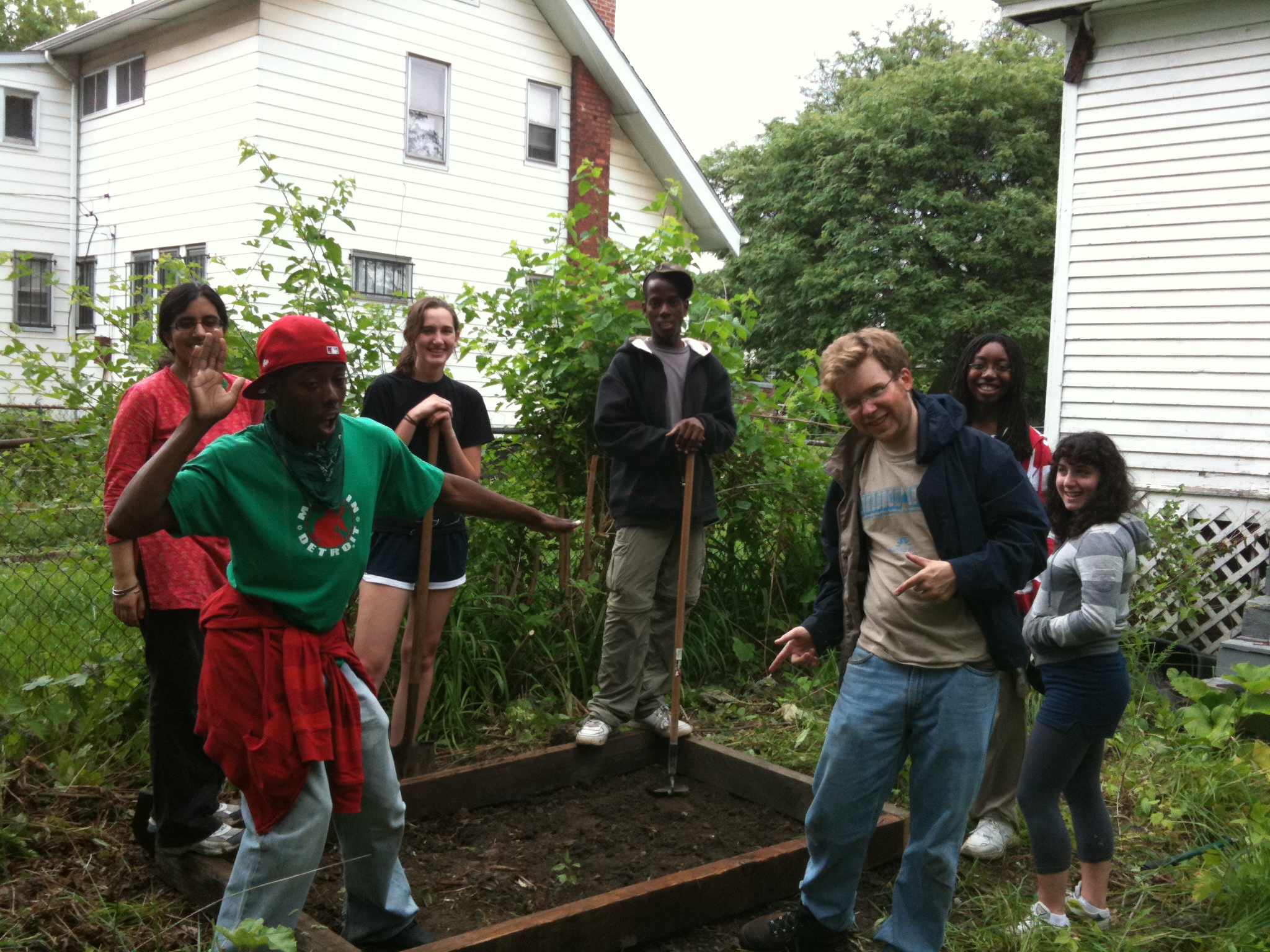
This past Thursday, I learned to soder, or to speak very technically, sweat pipes. Later that day, we built a bench out of discarded wood combined with the trunk of a tree I had cut down earlier in the day. This doesn’t sound too meaningful, but in actually it pretty profoundly represents the genius of GELT, and why I decided to spend my summer in Highland Park.

You see, sodering and making a bench share the attribute of being work that engages with ‘the good’. Sorry for lapsing into jargon, but what I mean is that this type of labor engages with the human need for excellence. Further, in this type of labor, you know if you reached the ‘Good’- the bench either holds weight and stands straight, or it doesn’t. The pipes either hold water, or they don’t. To me at least, this presents a welcome relief from the abstract realm of academia.

My love for this type of work isn’t just born out frustration with intellectual debates, I also find that his kind of work offers a certain satisfaction in that it actually produces. At the end of the day, I have a pipe system and a bench to show for my labor, and the knowledge that I have produced something useful in this world.

This production is the driving force behind GELT. I find that the supreme virtue of GELT in comparison to my previous experiences in the sustainability movement is that GELT has a unique focus on producing a tangibly greener world. Instead of producing memos, GELT produces raised beds, hoop houses, and cob ovens. This is why I chose to spend my summer in Highland Park- it allows me to put my beliefs into practical action, and physically create the green world I want to live in.

Meetings with reps of Sens Klobuchar and Franken, say what?

Working for two congresspersons last summer gave me a great perspective on all the work involved in hearing constituent concerns in a congressional seat. Last Thursday I was on the other side.  With our friend Reed Aronow, some SoS-TC folks and I met with aides from Senator Klobuchar and Senator Franken’s Twin Cities offices.  Reed organized these two meetings through Show Me Democracy and invited us along. Politics has always been one of my passions, and it was energizing to be a constituent, to actually get the chance to argue for what I believed was just. Instead of listening to other peoples’ opinions, I had the chance to voice mine.

Sen Amy Kolbuchar

Sen Al Franken

First, we met with  Leslie Kandaras, Senator Klobuchar’s aide. Standing outside the office, waiting for the others to arrive, going over who was to say what, writing and illustrating our large poster-board letter, I couldn’t help but be excited and also nervous.  Thankfully, Leslie was very supportive of our organization and resonated with all our policy requests. The meeting was rather spontaneous, and many of the speaking roles were decided at the last minute.  That worked to our advantage, keeping the conversation genuine and organic.  We hit home and were able to go through every point we wanted with time to spare.

Running off of the energy from our successful meeting with Ms. Kandaras, much of the group went to meet with an aide from Senator Franken’s office, Charlie Poster.  Charlie seemed like a pretty shrewd guy and questioned most policy suggestions we threw out.  While not supportive per se, Charlie provided much needed discussion on these issues.  In the end, we did not falter, though his challenging questions threw us off of our intended order, forcing us to improvise.  It was fun being pushed a little, and in the end, we pushed back on Senator Franken, asking him to champion, not just support, several environmental measures.

Here are the main policies we asked Franken and Klobuchar to spearhead in the Senate in our “Wish List”:

  • Reduce subsidies for industrial-grade corn and soy, and reallocate that money to subsidize local, organic small-scale agriculture.
  • Tie subsidy payments to acres farmed instead of bushels yielded.
  • Support the Feinstein bill, which would extend the 30% investment tax credit to renewable energy manufacturing.
  • Support PACE and overrule Fannie Mae and Freddie Mac’s rejection of it.
  • Champion a National Complete Streets bill like the one recently signed into Minnesota state law.

It was a great experience and I hope that Klobuchar and Franken step up as leaders in the ensuing energy, agriculture, and climate debates in the Senate.

————————————————————————————————————————————————-

This post written by David Isenberg, a Summer of Solutions Twin Cities participant.

Listening to understand…the conservative viewpoint?

I find it pretty difficult to be a “progressive” thinker and avoid letting criticism leak into my consciousness. The nature of the work I’m doing with Summer of Solutions-Twin Cities causes me to encounter comments along the lines of “these kids don’t know what they’re doing” or “what the heck is environmental justice?” pretty frequently. [Don’t read the comment thread in the Star Tribune article that our dear Martha wrote unless you want to have your faith in the Minnesotan people trampled on a little bit]

I tend to label, for better or for worse, this kind of response as “conservative” (though not Republican). When I think of these views, phrases like, “if you’re not conservative by 40 you have no brain,” and “guns don’t kill people,” and “the politics of fear,” pop into my head. The term “haters” usually comes to mind, closely followed by the uplifting message in Kanye West’s Stronger.

I find it hard not to get bogged down by the Haters. I find myself slipping into an oppositional mindset of “Us vs Them,” labeling people I meet “us” or “them”.

I realize that this mindset is pretty unconstructive. Especially in doing research about rural energy infrastructure and trying to engage rural communities as well as urban populations, I’ve learned that there are no friends or enemies, there are only opportunities for collaboration. Nevertheless, I have attempted to further my understanding of the conservative point of view (and thus advance my quest to become a Rural Minnesotan) by picking up the following read at the local library’s used book shelf:

“Conservatize Me” by John Moe

A short book that follows the originally liberal Seattlean author on a one-month journey to discover if, by immersing himself in his perception of conservative culture (that includes a wardrobe change, country music soundtrack, and interviews with conservative pundits), he can convert to the right.

So. Entertaining.

While the book is mainly targeted towards the sarcastic, Northwestern US reader (who I identify heavily with), it is a wonderfully humorous example of the art of  “listening to understand, not to respond.” Highly recommended to fans of caustic wit and others who have wondered “WHY?” in the face of conservative media.

It’s been a good reflection tool for me this summer, especially when pondering how to include everyone in the green economy.

—————————————————————————————————————————————————

This post cross-posted from Solutions, shamushions by Natalie Camplair

More Using Less

I came to environmental issues initially from what seems to me to be a very middle class standpoint. My family had always been frugal, adverse to waste, etc., but these were choices that we made from some sense of social responsibility and personal financial responsibility, not absolute necessity. Moving my things out of my dorm room after my first year of college, I realized how much arbitrary stuff I’d kept throughout the year because of my socialized (and possibly genetic?) aversion to throwing things away. But this also meant that I had accumulated plenty of stuff, which made me think about the fact that despite the fact my family and I may have opted to not live excessively, we never went without, and certainly have always had small luxuries.

Therefore, as I gradually came to engagement in environmental issues growing up, I faced what I feel is, at least in my experience, a somewhat common paradigm that “doing stuff that’s good for the environment” means sacrifice. However, I always had this idea – that always felt vaguely idealistic due to current well-entrenched systems – that it shouldn’t mean sacrifice, that there were common sense ways, for example that more localized food production should be able to be environmentally sustainable and build local economies. However, I never felt particularly empowered to be able to make this happen.

My thoughts in the last few months about Cooperative Energy Futures (CEF) have been gradually informing this idea, and tonight Timothy told his story of growing up (which I don’t really want to delve into here because I feel it’s still his story to tell) and I felt like the way in which I perceived his observations and experiences in a way complemented mine. To describe what I took from his story tonight, I’m going to go with something else I’ve heard Timothy say, over a month ago: “Let’s see lack as an asset.” I see this as a way that can (maybe in different ways depending on background, but maybe not, I don’t know) engage people from many class backgrounds (both the “haves” and “have-nots”, let’s say) in ventures that are both environmentally and economically sustainable.

The model being tested by CEF understandably seems unusual: capitalizing energy efficiency can also be described as creating something out of less, which runs opposite to most modern notions about wealth creation. While this is not an entirely new concept (see the ’70s cookbook, More With Less), carrying it out on any scale and with distinct entrepreneurial intent is definitely not a widely-thought-about idea, but it has lots of opportunity as we’re getting to the point at which continued excess is seeming unfeasible. However, less excess doesn’t mean the end of “business.”

Tonight I was told that CEF has been described as “a different kind of more,” which I see as very well capturing what the future will look like in a myriad of sectors. This is a different type of business plan, and it allocates value differently in some ways, but it’s still a business plan. Such a business can still create value and support people.

[Note: Our community conversation I reference was under the understanding of confidentiality, and I got Timothy’s permission to reference him and his comments.]

——————————————————————————

Note: This post cross-posted from Discovering Solutions by Christina Getaz.

Corvallis SoS Launch Week

The NICE Summer of Solutions launch week imploded my brain and lassoed my soul, forcing me to reflect on my life in ways I never have, but have always wanted to. The deep and penetrating introspection divulged thoughts I’d never thought, connections I’d never seen, and worldviews I’d never considered. These views exploded outward from within making me feel and see the world in entirely and fundamentally different ways. These trainings lassoed my soul, asking not only what do I want to do, but what I need to do it, and how I am going to. The most powerful realization for me was that I can dream big, big, big, but I never seem to plan how to reach those dreams. This was a pretty amazing realization for me because I’ve always known this, but haven’t felt so determined to overcome it before. But more than introspection, this week was about imagining ourselves in our highest vision and visioning a world beyond the horizon. Loosening the lasso, my soul soared. It’s not so much that I haven’t had visioning sessions before, but that I realized by thinking and stating out loud the world we wished to see, by living it in our thoughts, words, and actions, we created it right where we were. Our training week was spectacular.

You know, clicking on the Summer of Solutions tab on the Grand Aspirations site, I saw our lonesome green balloon in Oregon, signifying our program in Corvallis. Despite being the only SoS program west of the Mississippi, I couldn’t be prouder and happier to be here.

Urban Growth

authored by GELT-er Ayoola White

Green Economy Leadership Training (GELT) has been filled with varied challenges. One day we’re constructing raised beds out of wood reclaimed from abandoned houses. The next, we’ll discuss applications of permaculture and the dangers of nuclear power. Since we are constantly defining and redefining our goals as a group, our activities tend to be hectic. Last Friday afternoon, we took on yet another challenge: canvassing residents to find candidates for free home energy improvements.

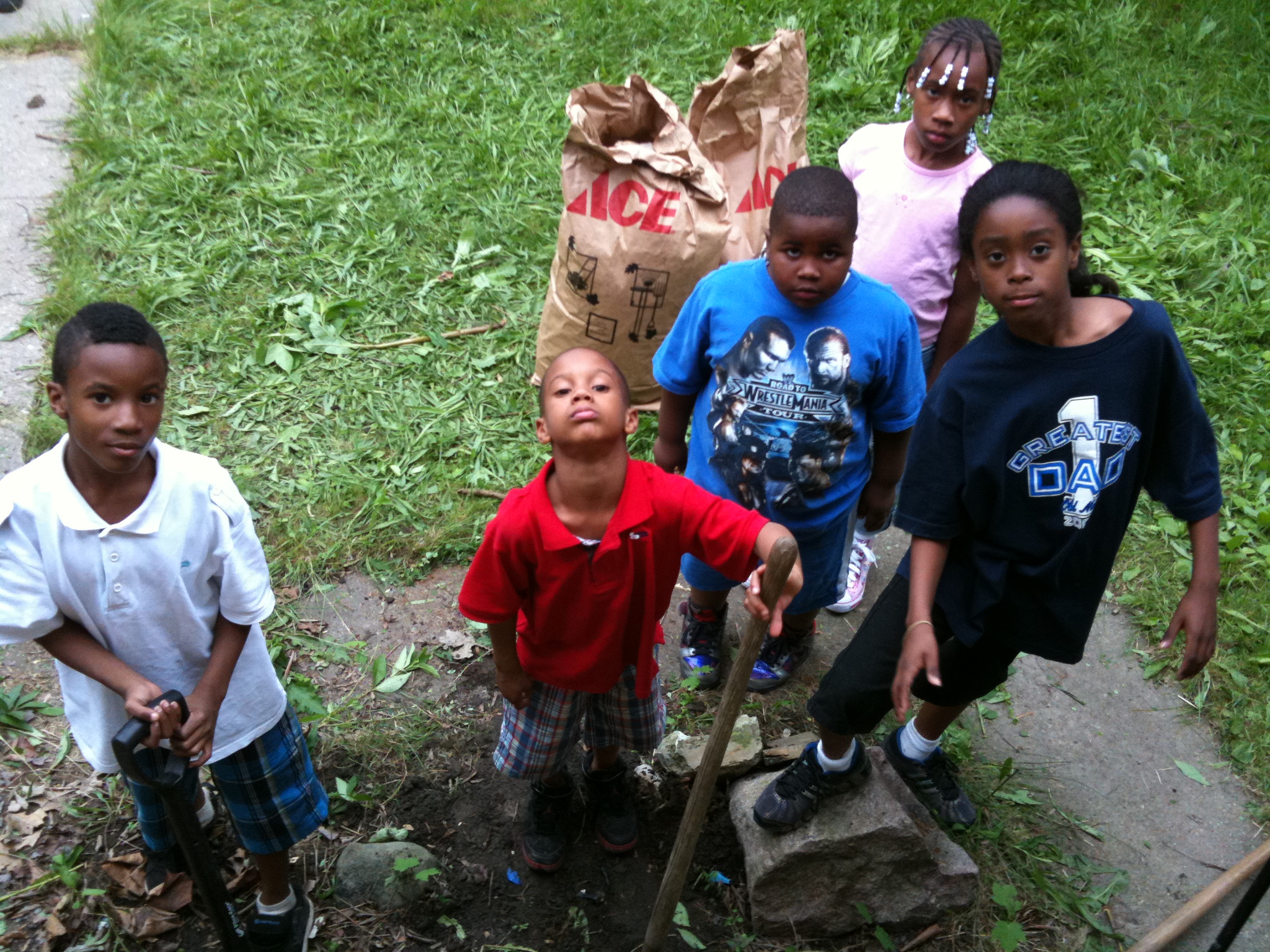
Hitherto that sweltering afternoon our primary interaction with the Highland Park community involved people from the neighborhood coming to us. Kids helped us pull weeds and remove bushes. Adults sat in on classes, sometimes, or walked around, carefully observing our work. Friday was the first day that we, the participants of GELT, collectively went to meet the people we’ve been working to serve. Armed with clipboards, sign-up sheets, and flyers, we fanned out.

Upon reaching the first household in my assigned turf, the southernmost region of Highland Park, I was stunned to discover that the words I had so smoothly recited that morning were not so smooth anymore. It was as though I suddenly had no clue what I was doing anymore. Luckily, my inner nervousness and confusion didn’t flow outward enough to repel absolutely everyone, and I was able to gather a few signatures in the first hour or so. I eventually tweaked my spiel to something that was comfortable for me to remember. But still, in the journey between each door, I kept scrutinizing my tactics. Am I talking too fast? The way I stammer is so embarrassing! Am I saying too much? Did I forget to say ‘thank you’ to that last lady? Is there something in my teeth?

Even when I was able to overcome self-consciousness, though, I felt that there was a moderate disconnect between me and the people I visited. Thankfully, most were friendly, and no one slammed a door in my face, but the people appeared wary of me sometimes. Given my unfamiliar face and the clipboard I was carrying, perhaps I was mistaken for a census worker or a salesperson before I opened my mouth to speak. Some were incredulous that the home energy visit I was describing was free. Others seemed suspicious of me, and they asked me where I was from and whether I worked for a utility company and was trying to get them to switch their service. It was as though there were walls of thick glass separating us, sometimes, making communication challenging.

In addition to reflecting on my own actions those of others, I was also mindful of my physical surroundings. My canvassing partner and I covered a total of three streets in that afternoon. Each street had its own character, its own look. One street was filled with lovely houses and breathtaking gardens, but there weren’t that many people outside enjoying them. The next had houses that were shabbier, but more people were congregating and conversing on porches. The last one was a mix of the two. What a contrast from my neighborhood, where every house, every street is a copy of all the others.

Despite the many abandoned and decrepit houses I saw everywhere, I noticed that immense vibrancy existed among the pockets of squalor. People were walking around, greeting their neighbors. Kids played together and adults watched out for them. What’s more, there were plants growing EVERYWHERE. Lawns, left untamed, exploded with greenery. Leaves and vines grew out of stairs and floorboards. It’s as if millions of sinewy green hands are emerging from the ground to pull the houses into the earth. How ironic it is that places like Highland Park are often thought of as sites of urban decay, when so much growth is taking place.

Since our goal in GELT is community building, not gentrification, it is vital to tap into the positivity that already exists here, rather than assuming that we have all the answers and that we’re here to rescue the weak and the downtrodden. On Friday, we GELT-ers made connections through our canvassing work that I hope will evolve into a strong network of people who will shape their neighborhoods into comfortable, sustainable living spaces. Together, we’ve already gathered about 50 signatures from people who want to make their homes more energy efficient. From here, our impact shall grow.

Reimagination: When Recovery Doesn’t Cut It

A number of big-picture things are not going to well recently. The Gulf Oil spill shows no signs of ceasing, and now the Atlantic hurricane season threatens to halt control efforts and spread petroleum around the American South (perhaps even through rain!?). Despite massive youth electoral efforts in 2008 to place climate champions in political leadership, policy efforts towards climate and energy solutions have been lethargic at best. And despite over a trillion dollars in economic stimulus spending, recent data shows that the national economy is still slipping steadily deeper into decline.

These three cases display a common pattern – failure (of energy companies, the political process, and our national economy) is being treated like an accident from which we need to recover to normal working order.

The accident-recovery story is holding us back in three very important ways:
1. It helps erase our memory of the ways that business as usual hasn’t been working for a great many people for a very long time.
2. It disguises the fundamental and systemic nature of the challenges we face and legitimizes management of the problem using the ways of thinking that created them, even when this way of thinking proves ineffective repeatedly.
3. Because it normalizes business as usual, it mystifies reimaginative approaches that shift power and agency, making them seem unrealistic or irrelevant.

In this blog post, I’ll demonstrate how this happens in the context of my current work in the Twin Cities Summer of Solutions in Minnesota, and how we’re trying to overcome accident-recovery stupor.
Continue reading

A Critique of the United States Social Forum

Authored by Monika Kothari: Her 2nd installment during the GELT

The USSF has a list of “principles”  at the beginning of its program that almost nobody reads. I didn’t even know that these existed until a woman in one of my workshops began quoting from it (and was met with looks of confusion). To me, this fact alone, the fact that few people read these principles or even know that they existed, inherently means that not everyone—perhaps not even a majority—agree with and adhere to them. Actually, I found that one of the clearest underlying problems of the USSF is the lack of vision, unity, and shared goals. The forum succeeded in bringing together people of diverse backgrounds, and with diverse agendas, into the same space in time…but more often than not, failed at allowing these interest groups to confront and interact with each other in a meaningful and productive way. Even with all of these thousands of socially conscious people on the same plane, it is virtually impossible to make important breakthroughs as the “artists,” “feminists,” “environmentalists,” “socialists,” and “anti-Zionist Jews” section themselves off. More than that, there is an overwhelming sense of personal isolation and aloneness, both physically and mentally. Some people withdraw from the massive crowds, while others become so tightly wrapped in the cocoons of their organizations, logos, t-shirts, causes, and identities that the human beings disappear behind all the politics. Many of us found ourselves confused, disoriented, and frustrated, and in those moments of mental exhaustion, felt incredibly alone, removed, and isolated.

Continue reading