Barter to Cash with MN350

This is the fourth post in a series of introductions by Sustainable Community Organizers working in the Midwest. This post is by Patricia Lamas from the Twin Cities Summer of Solutions program.

ImageHello! My name is Patricia Lamas, and I began working with MN350 this September on a project called the “Barter to Cash Network.” We’re developing a new system for creative resource generation and community engagement, and we aim to spread it as a model for nonprofits and to our partners in climate movement. How will it work? Instead of sustaining our organization on direct monetary donations, we are inviting people to offer their diverse skills and resources – truly anything on hand. Maybe Susan has a surplus of cinder blocks, or a knack for home repair. Jim might take his dog to the park every morning, and wouldn’t mind picking up another playmate on the way. Whether or not MN350 can use these contributions, someone else in the community can! The idea is a system similar to craigslist.com, only the proceeds go to funding the work of the organization. This way, donations can be infinitely creative, and just as fun – all while creating new connections among members of the local community. Continue reading

YEA Corps Launch Day

My name is Carey deVictoria-Michel. This summer, I was a participant in the Twin Cities Summer of Solutions and during this time my eyes were opened to all the amazing things that are happening in this city.  Through funding available to Summer of Solutions participants, I was able to create a position for myself at YEA Corps, a Minneapolis based non-profit that leads educational programs focused on entrepreneurship and sustainability. This is the first blog post in a series by the five Summer of Solutions alumni who will be building their own careers with support from Grand Aspirations in the coming year.

Me (r) talking to a student at the YEA Corps launch day at Unity Charter School.

My job with YEA Corps this year will be to mange a project at the YEA Corps program at the Minnesota Internship Center at the Unity Campus. Unity is a charter school located in North Minneapolis working with students who come from diverse backgrounds, in a neighborhood considered to be a food desert. YEA Corps and Minnesota Internship Center received a grant from Hennepin County to start an experiential learning program for environmental education in North Minneapolis. By the end of the year these kids will have built their own aquaponics systems, created their own business and marketing plan to sell fresh produce and fish, and have learned about sustainability and food systems. We had our big launch day with the students this past week. Continue reading

Hello to Solutionaries from the Twin Cities!

Welcome to TC SoS!

Hi all! Allow me to introduce myself, my name is Courtney Dowell, and I am one of the new program leaders in the Twin Cities team. I am very excited to be a part of Summer of Solutions for the first time and get our programs planned and underway. I wanted to give everyone an update of what we are doing here in Minneapolis and introduce our new 2012 Program Leader Team to Solutionaries.

Courtney (L) and Libby (R). Twin Cities New Program Leaders.

This year we have two new program leaders, Libby London and me. Libby and I are both seniors at the U of M and excited to be planning and leading our Urban Agriculture program. Also, on our program leader team, are veterans Ruby Levine and Daria Kieffer. Together, we are heading up four programs this summer. First, we are starting a community garden for our participants to plant, grow, and learn with the community. Second, we are partnering with other Minneapolis organizations to pilot a bike caravan to get youth to summer programs. And, in addition, we are continuing to work the Minneapolis Hubs or ARISE and Our Power. Continue reading

Developing Leadership

A tomato plant viewed from below with the sun in the backround.

Photography by Martha Pskowski.

Since September, I’ve been working on the national Leadership Development Team, planning for training weeks at Summer of Solutions programs around the country. We’ve done a lot since we got started, reviewing and editing old trainings as well as developing new ones. I have been excited to discover that the members of our team are all really motivated to make Grand Aspirations an organization that works against oppression. This past weekend, I turned the anti-oppression workshop that we did during the Twin Cities program in 2010 into a replicable template that other programs can use. As I was reading over the notes my co-facilitator Hannah had sent me, it really brought me back to the experience. I was reminded how powerful of an activity this was. By talking about our own identities and the way that we experienced those identities, we were able to begin a practice of speaking honestly from our own experiences. For me, there was the added value of learning how to facilitate a conversation about deeply felt identities that builds towards trust and openness rather than closing people off from each other.

As I was discussing with Hannah the best way to attribute the work that had gone into creating this workshop, I realized all the different perspectives and experiences that had gone into making this template the way it is now. While we will do our best to capture the people who contributed directly in the sources listed at the top of all Grand Aspirations templates, it got me thinking about all the people who it would be impossible to cite who contributed. Conversations that I have had and articles and blog posts that I’ve read shaped the way I wrote the template, and I’m sure that there is a web of connection and learning back from every person in every organization who worked on this training. As different facilitators give this training in the future, they will bring their own personal experience to the way that they facilitate it.

To me, this diversity of experience and opinion is one of the most important reasons to work towards an anti-oppressive organization. People with homogeneous identities are different people — I am different from my sister, for example, despite our identical class background, race, ethnicity, geographic location, religious upbringing, gender, and parents — but we can’t create solutions for a heterogeneous world based on only our experience. I am excited to work with Leadership Development Team to see how we can recognize and expand diverse leadership in the organization and our programs.

Reclaiming prosperity

“…it is impossible for most of the world to feed itself a diverse and healthy diet through exclusively local food production — food will always have to travel; asking people to move to more fertile regions is sensible but alienating and unrealistic; consumers living in developed nations will, for better or worse, always demand choices beyond what the season has to offer…”

James E. McWilliams “Food that Travels Well” The New York Times August 6, 2007

Say what?  I thought better of you, NYT.  While McWilliams does raise some valid points, this mentality falls short in two major ways.  His assumptions mirror outlooks about sustainability I have often encountered which also apply to clothing, building practices, transportation and more.  Good thing there are Solutionaries on the case.

1)      This view doesn’t look far enough back.  Transportation of food over long distances is a relatively recent phenomenon in the grand scheme of things.  There was a time when everyone ate food that was more or less local.  Then refrigerated transportation happened, and the industrial revolution and agri-business squeezing out small farmers and before you know it, local is a novelty.  This all happened in the course of a century or two.  Is inertia so strong we can’t get back to this way of living? Judging from past moments in history, such as WWII when many Americans started Victory gardens, I beg to differ.

2)      It doesn’t look far enough ahead.  Oil is what fuels our transportation system and alternatives like corn ethanol aren’t looking so hot.  Oil is running out, and fast.  Since 1968, the world has been using more oil than it has discovered.  Just this month after a cabinet meeting, Saudi Arabia’s King Abdullah answered a Zawya Dow Jones Newswires reporter’s question: “I told them [the cabinet] that I have ordered a halt to all oil explorations so part of this wealth is left for our sons and successors, God willing.”[1]
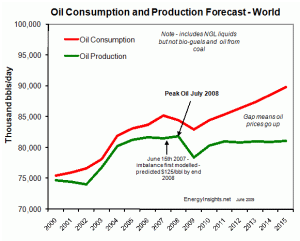
One projection of peak oil from energyinsights.net

McWilliams doesn’t think about all the subsidies that have made oranges and coffee beans in New York City cheaper than swiss chard from a Hudson Valley farmer. The subsidies and the artificially suppressed cost of gas for transportation all create a false sense of economy in far-flung production.  When the U.S. starts paying an arm and a leg for the last dregs of oil fields, local won’t look so much like a “choice”.

A big part of being solutionary to me is a type of long-term thinking that McWilliams sorely lacks.  I’m not just in this for my generation.  If I were I might focus on R & D of energy resource extraction.  And I’m not just in it for my kid’s generation.  I’m in it to figure out a way that humans can co-exist on this earth alongside all the other species we haven’t wiped out yet, indefinitely.  This takes looking way back in the past before looking too far into the future.  Humans have lived without fossil fuels for all of our history except the tiny blip of the last two centuries.  I’m not saying we have to go back to the Stone Age, just that the Earth can support a human population that doesn’t suck it dry.

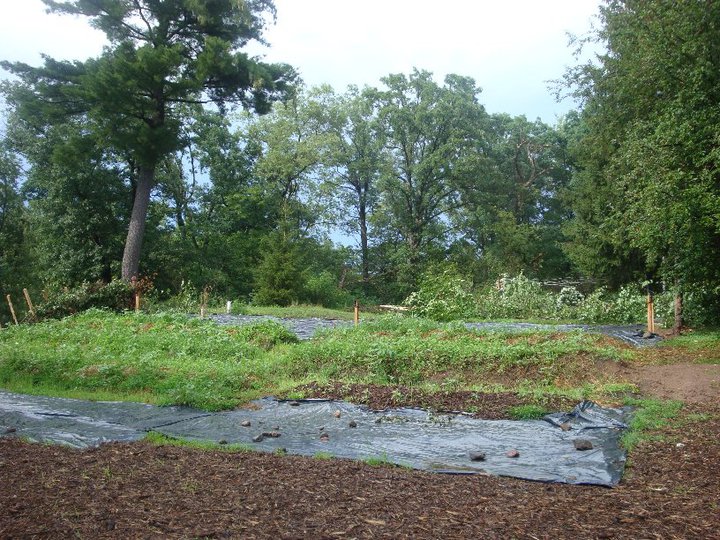
One of my neighbors kept apples and potatoes all through last winter in her basement, no fossil fuels required.  Local apples in a Minnesota February; it can be done, no science degree required.  I’ve spun and knitted wool from Maryland sheep into hats and mittens that never left their state of origin in production or use.  I joined St Paul high school youth, the Lily Springs Farm crew and other Solutionaries working on a natural fence in Wisconsin this past weekend.  Just pine trees, brush and some hard labor will keep rabbits out of the crops.   Summer of Solutions is helping Sibley Bike Depot get bikes to people so they can get around without fossil fuels.

Natural building at Lily Springs Farm

And what’s so beautiful to me is these changes feel like anything but sacrifices.  It’s taking our future out of the hands of corporations, institutions and bureaucrats and into our own hands.  To me, being Solutionary means transforming the world so my life is more prosperous than it ever could be in our current, broken and unjust system.


[1] http://community.nasdaq.com/news/2010-07/has-peak-oil-arrived.aspx?storyid=29215

More Using Less

I came to environmental issues initially from what seems to me to be a very middle class standpoint. My family had always been frugal, adverse to waste, etc., but these were choices that we made from some sense of social responsibility and personal financial responsibility, not absolute necessity. Moving my things out of my dorm room after my first year of college, I realized how much arbitrary stuff I’d kept throughout the year because of my socialized (and possibly genetic?) aversion to throwing things away. But this also meant that I had accumulated plenty of stuff, which made me think about the fact that despite the fact my family and I may have opted to not live excessively, we never went without, and certainly have always had small luxuries.

Therefore, as I gradually came to engagement in environmental issues growing up, I faced what I feel is, at least in my experience, a somewhat common paradigm that “doing stuff that’s good for the environment” means sacrifice. However, I always had this idea – that always felt vaguely idealistic due to current well-entrenched systems – that it shouldn’t mean sacrifice, that there were common sense ways, for example that more localized food production should be able to be environmentally sustainable and build local economies. However, I never felt particularly empowered to be able to make this happen.

My thoughts in the last few months about Cooperative Energy Futures (CEF) have been gradually informing this idea, and tonight Timothy told his story of growing up (which I don’t really want to delve into here because I feel it’s still his story to tell) and I felt like the way in which I perceived his observations and experiences in a way complemented mine. To describe what I took from his story tonight, I’m going to go with something else I’ve heard Timothy say, over a month ago: “Let’s see lack as an asset.” I see this as a way that can (maybe in different ways depending on background, but maybe not, I don’t know) engage people from many class backgrounds (both the “haves” and “have-nots”, let’s say) in ventures that are both environmentally and economically sustainable.

The model being tested by CEF understandably seems unusual: capitalizing energy efficiency can also be described as creating something out of less, which runs opposite to most modern notions about wealth creation. While this is not an entirely new concept (see the ’70s cookbook, More With Less), carrying it out on any scale and with distinct entrepreneurial intent is definitely not a widely-thought-about idea, but it has lots of opportunity as we’re getting to the point at which continued excess is seeming unfeasible. However, less excess doesn’t mean the end of “business.”

Tonight I was told that CEF has been described as “a different kind of more,” which I see as very well capturing what the future will look like in a myriad of sectors. This is a different type of business plan, and it allocates value differently in some ways, but it’s still a business plan. Such a business can still create value and support people.

[Note: Our community conversation I reference was under the understanding of confidentiality, and I got Timothy’s permission to reference him and his comments.]

——————————————————————————

Note: This post cross-posted from Discovering Solutions by Christina Getaz.

Have the alternatives been exhausted? (After being exhaustively explored?)

Xcel Energy has one reasonable rationale for their proposed high-voltage power line through South Minneapolis, specifically the Phillips neighborhood, near Lake Street, at first glance: there has been growth, especially in institutions such as hospitals that use large amounts of energy and indisputably require reliable energy. Blackouts in hospitals are obviously a bad thing.

However, is putting through a new power line that’s just a continuation of the current energy-production regime the only option to provide reliable energy? In the face of climate change and fossil fuel depletion and economic challenges, is that the best system to perpetuate? What about being able to use less energy through efficiency measures, many of which are relatively easy, inexpensive and can be done by the large organizations as well as by individual households all around the area? What if there were a few solar panels on homes and small businesses? These options aren’t impossible, are they?

This might not provide all of the community’s energy, but could it possibly be a method in which the energy demand gap could be made up – and provide a basis so that more of the community’s energy could be produced in such manners in the future? Could it engage the community in working individually and collectively on their own energy? Are families,panaderias, groceries, hospitals, banks, churches, mosques, YWCAs and Scandinavian gift shops limited to being consumers of energy, disconnected from its mysterious production? Or, could they be a part of taking ownership of even a small part of what daily powers their homes and places of business, recreation and worship?

More fundamentally, what are the details of the increase in energy usage? What do the various individuals and organizations in the community think about their energy usage? Are some of them already employing energy efficiency materials? Is there any hidden interest in more energy efficiency and renewables that just haven’t found the opportunity to manifest itself? Could this be that opportunity?

Essentially, do we really know if the new power line is necessary if all these questions haven’t been answered? Can we find answers to a lot of these questions? What might those answers tell us about the necessity of the transmission line?

Majora Carter + Summer of Solutions = Awesome

Isn’t it great when you get to meet someone you really admire, and she turns out to be just as intelligent, interesting, and just darn nice as you had always hoped? That was my experience at Majora Carter’s Green The Ghetto event in North Minneapolis. The event was put on by Matt Entenza’s campaign for governor. Majora even took a picture with those of us who’d come from the Twin Cities Summer of Solutions program:

Look how happy we are!

Solutionaries with Majora Carter

Continue reading