Reclaiming prosperity

“…it is impossible for most of the world to feed itself a diverse and healthy diet through exclusively local food production — food will always have to travel; asking people to move to more fertile regions is sensible but alienating and unrealistic; consumers living in developed nations will, for better or worse, always demand choices beyond what the season has to offer…”

James E. McWilliams “Food that Travels Well” The New York Times August 6, 2007

Say what?  I thought better of you, NYT.  While McWilliams does raise some valid points, this mentality falls short in two major ways.  His assumptions mirror outlooks about sustainability I have often encountered which also apply to clothing, building practices, transportation and more.  Good thing there are Solutionaries on the case.

1)      This view doesn’t look far enough back.  Transportation of food over long distances is a relatively recent phenomenon in the grand scheme of things.  There was a time when everyone ate food that was more or less local.  Then refrigerated transportation happened, and the industrial revolution and agri-business squeezing out small farmers and before you know it, local is a novelty.  This all happened in the course of a century or two.  Is inertia so strong we can’t get back to this way of living? Judging from past moments in history, such as WWII when many Americans started Victory gardens, I beg to differ.

2)      It doesn’t look far enough ahead.  Oil is what fuels our transportation system and alternatives like corn ethanol aren’t looking so hot.  Oil is running out, and fast.  Since 1968, the world has been using more oil than it has discovered.  Just this month after a cabinet meeting, Saudi Arabia’s King Abdullah answered a Zawya Dow Jones Newswires reporter’s question: “I told them [the cabinet] that I have ordered a halt to all oil explorations so part of this wealth is left for our sons and successors, God willing.”[1]

One projection of peak oil from energyinsights.net

McWilliams doesn’t think about all the subsidies that have made oranges and coffee beans in New York City cheaper than swiss chard from a Hudson Valley farmer. The subsidies and the artificially suppressed cost of gas for transportation all create a false sense of economy in far-flung production.  When the U.S. starts paying an arm and a leg for the last dregs of oil fields, local won’t look so much like a “choice”.

A big part of being solutionary to me is a type of long-term thinking that McWilliams sorely lacks.  I’m not just in this for my generation.  If I were I might focus on R & D of energy resource extraction.  And I’m not just in it for my kid’s generation.  I’m in it to figure out a way that humans can co-exist on this earth alongside all the other species we haven’t wiped out yet, indefinitely.  This takes looking way back in the past before looking too far into the future.  Humans have lived without fossil fuels for all of our history except the tiny blip of the last two centuries.  I’m not saying we have to go back to the Stone Age, just that the Earth can support a human population that doesn’t suck it dry.

One of my neighbors kept apples and potatoes all through last winter in her basement, no fossil fuels required.  Local apples in a Minnesota February; it can be done, no science degree required.  I’ve spun and knitted wool from Maryland sheep into hats and mittens that never left their state of origin in production or use.  I joined St Paul high school youth, the Lily Springs Farm crew and other Solutionaries working on a natural fence in Wisconsin this past weekend.  Just pine trees, brush and some hard labor will keep rabbits out of the crops.   Summer of Solutions is helping Sibley Bike Depot get bikes to people so they can get around without fossil fuels.
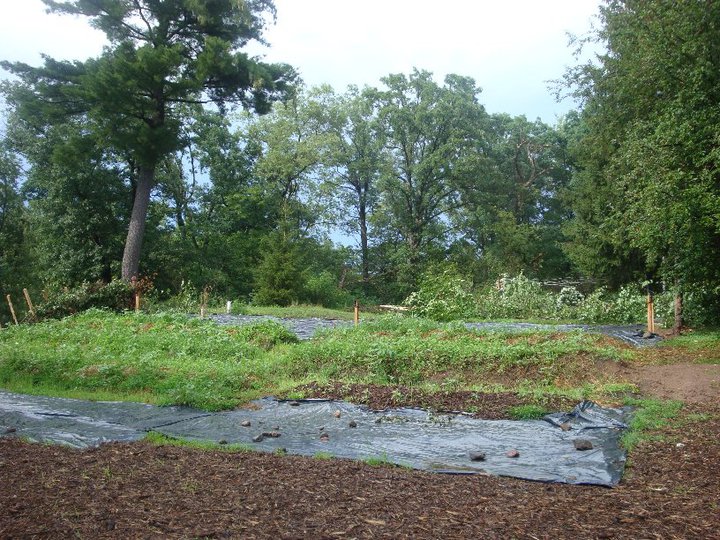
Natural building at Lily Springs Farm

And what’s so beautiful to me is these changes feel like anything but sacrifices.  It’s taking our future out of the hands of corporations, institutions and bureaucrats and into our own hands.  To me, being Solutionary means transforming the world so my life is more prosperous than it ever could be in our current, broken and unjust system.


[1] http://community.nasdaq.com/news/2010-07/has-peak-oil-arrived.aspx?storyid=29215
More Using Less

I came to environmental issues initially from what seems to me to be a very middle class standpoint. My family had always been frugal, adverse to waste, etc., but these were choices that we made from some sense of social responsibility and personal financial responsibility, not absolute necessity. Moving my things out of my dorm room after my first year of college, I realized how much arbitrary stuff I’d kept throughout the year because of my socialized (and possibly genetic?) aversion to throwing things away. But this also meant that I had accumulated plenty of stuff, which made me think about the fact that despite the fact my family and I may have opted to not live excessively, we never went without, and certainly have always had small luxuries.

Therefore, as I gradually came to engagement in environmental issues growing up, I faced what I feel is, at least in my experience, a somewhat common paradigm that “doing stuff that’s good for the environment” means sacrifice. However, I always had this idea – that always felt vaguely idealistic due to current well-entrenched systems – that it shouldn’t mean sacrifice, that there were common sense ways, for example that more localized food production should be able to be environmentally sustainable and build local economies. However, I never felt particularly empowered to be able to make this happen.

My thoughts in the last few months about Cooperative Energy Futures (CEF) have been gradually informing this idea, and tonight Timothy told his story of growing up (which I don’t really want to delve into here because I feel it’s still his story to tell) and I felt like the way in which I perceived his observations and experiences in a way complemented mine. To describe what I took from his story tonight, I’m going to go with something else I’ve heard Timothy say, over a month ago: “Let’s see lack as an asset.” I see this as a way that can (maybe in different ways depending on background, but maybe not, I don’t know) engage people from many class backgrounds (both the “haves” and “have-nots”, let’s say) in ventures that are both environmentally and economically sustainable.

The model being tested by CEF understandably seems unusual: capitalizing energy efficiency can also be described as creating something out of less, which runs opposite to most modern notions about wealth creation. While this is not an entirely new concept (see the ’70s cookbook, More With Less), carrying it out on any scale and with distinct entrepreneurial intent is definitely not a widely-thought-about idea, but it has lots of opportunity as we’re getting to the point at which continued excess is seeming unfeasible. However, less excess doesn’t mean the end of “business.”

Tonight I was told that CEF has been described as “a different kind of more,” which I see as very well capturing what the future will look like in a myriad of sectors. This is a different type of business plan, and it allocates value differently in some ways, but it’s still a business plan. Such a business can still create value and support people.

[Note: Our community conversation I reference was under the understanding of confidentiality, and I got Timothy’s permission to reference him and his comments.]

——————————————————————————

Note: This post cross-posted from Discovering Solutions by Christina Getaz.

Corvallis SoS Launch Week

The NICE Summer of Solutions launch week imploded my brain and lassoed my soul, forcing me to reflect on my life in ways I never have, but have always wanted to. The deep and penetrating introspection divulged thoughts I’d never thought, connections I’d never seen, and worldviews I’d never considered. These views exploded outward from within making me feel and see the world in entirely and fundamentally different ways. These trainings lassoed my soul, asking not only what do I want to do, but what I need to do it, and how I am going to. The most powerful realization for me was that I can dream big, big, big, but I never seem to plan how to reach those dreams. This was a pretty amazing realization for me because I’ve always known this, but haven’t felt so determined to overcome it before. But more than introspection, this week was about imagining ourselves in our highest vision and visioning a world beyond the horizon. Loosening the lasso, my soul soared. It’s not so much that I haven’t had visioning sessions before, but that I realized by thinking and stating out loud the world we wished to see, by living it in our thoughts, words, and actions, we created it right where we were. Our training week was spectacular.

You know, clicking on the Summer of Solutions tab on the Grand Aspirations site, I saw our lonesome green balloon in Oregon, signifying our program in Corvallis. Despite being the only SoS program west of the Mississippi, I couldn’t be prouder and happier to be here.

Have the alternatives been exhausted? (After being exhaustively explored?)

Xcel Energy has one reasonable rationale for their proposed high-voltage power line through South Minneapolis, specifically the Phillips neighborhood, near Lake Street, at first glance: there has been growth, especially in institutions such as hospitals that use large amounts of energy and indisputably require reliable energy. Blackouts in hospitals are obviously a bad thing.

However, is putting through a new power line that’s just a continuation of the current energy-production regime the only option to provide reliable energy? In the face of climate change and fossil fuel depletion and economic challenges, is that the best system to perpetuate? What about being able to use less energy through efficiency measures, many of which are relatively easy, inexpensive and can be done by the large organizations as well as by individual households all around the area? What if there were a few solar panels on homes and small businesses? These options aren’t impossible, are they?

This might not provide all of the community’s energy, but could it possibly be a method in which the energy demand gap could be made up – and provide a basis so that more of the community’s energy could be produced in such manners in the future? Could it engage the community in working individually and collectively on their own energy? Are families,panaderias, groceries, hospitals, banks, churches, mosques, YWCAs and Scandinavian gift shops limited to being consumers of energy, disconnected from its mysterious production? Or, could they be a part of taking ownership of even a small part of what daily powers their homes and places of business, recreation and worship?

More fundamentally, what are the details of the increase in energy usage? What do the various individuals and organizations in the community think about their energy usage? Are some of them already employing energy efficiency materials? Is there any hidden interest in more energy efficiency and renewables that just haven’t found the opportunity to manifest itself? Could this be that opportunity?

Essentially, do we really know if the new power line is necessary if all these questions haven’t been answered? Can we find answers to a lot of these questions? What might those answers tell us about the necessity of the transmission line?

Summer of Solutions – Worcester

Summer of Solutions in Worcester has been noticed! About a week ago, we were contacted by Lauren McShane from Worcester Magazine looking to do a piece on us. Some some of us got in touch with her to tell her what the program was all about and we met with her to take a photograph as well at our community garden over on Richards St. (unfortunately, it looks like the photo didn’t make it online). The link to the article is here: http://worcestermagazine.com/content/view/5394/

The Worcester program will be working on three project realms in urban gardening and creating a pamphlet on it with the Regional Environmental Council, home and public building weatherization in Worcester and community art projects possibly including murals, sculptures in the parks and a DIY recycled fashion show.

We’re thrilled to have had this opportunity to get our message out to the media and the larger Worcester community and hopefully get some more people interested and involved! It’s shaping up to be a great summer and we hope everyone is just as excited as us.

-Jane Allegra, Worcester Carrier Pigeon

Summer of Solutions Worcester: It’s Artgarden Weather!

So there’s this giant community garden, right? And part of it is a huge plot filled with stalks of corn, but each ear is a can of spraypaint or a giant crayon or some sort of crazy crafty thing. The rest of the garden is full of regular plants, and there are people busily moving around, picking art and planting art and picking food and planting food. You look at it and you think to yourself “Wow, that’s some sort of amazing artgarden that spews fruit and beauty into the world. I want in on that!”

That’s how the SoS team envisions Worcester. It might not even be far from the truth. Worcester has quite a few hugely active community groups, whether they’re active in one neighborhood, the whole city, or throughout central Massachusetts. Last year, Summer of Solutions was one of those, working with gardens, spreading information on green job creation, and creating a Weatherization group that lives on to this day.

This summer, SoS 2010 is going to build on our old projects and pick up new ones. We will be continuing to partner with the existing Worcester groups interested in Community Gardening, we’ll expand our plots from last year, and we will create new plots and help foster communities of action around each of these gardens. We hope to work with the Regional Environmental Council – a group who does fantastic work within and around Worcester, especially with regards to community gardening – to make this set of projects run smoothly and integrate with extant projects.

Fayetteville Summer of Solutions Grows Community Power!

As Communications Facilitator for Summer of Solutions, I’m featuring every program to paint a broad picture of the depth and variety of solutions young people are building across the nation.

This post is drawn from a conversation I had with Amanda Bancroft, an AmeriCorps*VISTA volunteer at the OMNI Center for Peace, Justice, and Ecology. The main organizers of Fayetteville SoS are: Andrea Love, Maggie Strain, Karina Hunt, Banah Ghadbian, Jeanie Lopez-Hall, Chelsea Mouber, and Brian Kupillas. The post is co-authored by me and the Fayetteville team.

Leaders in the program have a strong interest in gardening and permaculture. There are already over 50 gardening projects, organizations, and networks in Fayetteville, and so Amanda sees the role of Summer of Solutions as one that will connect these already dynamic organizations together. The Fayetteville team has already partnered with the OMNI Center’s garden, the World Peace Wetlands Prairie, and the community garden at Unity church. In addition, the group has been given several acres of land and a greenhouse, which the team is hoping to develop for gardening.

Through building collective growing power in Fayetteville, Summer of Solutions participants will be facilitating a beautiful expansion of the amazing work already happening around the city.
Continue reading

Summer of Solutions Hits the Streets in Cleveland, OH!

As Communications facilitator of Grand Aspirations, I am featuring local programs to paint a picture of the diversity of solutions young people are building across the country. This week, I had the pleasure of interviewing Tim Krueger and Nora Graubard, two of the program leaders for Cleveland SoS. The other program leaders are Erika Zarowin, Ben Shapiro, and Phoebe Flaherty.

Leaders of Cleveland Summer of Solutions focus on connecting participants and interns with the broad network of organizations in Cleveland already working on issues of community development and sustainability.

Summer of Solutions in Cleveland is a project of the Ohio Student Environmental Coalition (OSEC). This coalition is a statewide network of student groups that work together to create a clean, safe, and just future. Participants in this program will be hired as interns of the OSEC, and will participate in as many aspects of the summer as they choose.

Members of the OSEC at their most recent retreat

The program’s main initiative is an energy efficiency project with the potential to effect change across the city.

Cleveland is an amazing city, with wonderful city officials to go with it. The goal of these elected officials is to weatherize every home in Cleveland in the next nine years. They are therefore partnering with SoS to collect data on weatherization in two key neighborhoods – Detroit-Shoreway and Clark Metro.

Participants will schedule interviews with residents of these blocks, collect data about receptivity to weatherization, residents’ income levels, and how much work is needed on the homes. As well as gathering information, participants will also teach residents about weatherization and energy efficiency.

After these interviews have been conducted, solutionaries will figure out what programs residents may be eligible for. This kind of follow-up will continue throughout the summer, with participants constantly striving to find the best way to meet the needs of residents, and by personally weatherizing homes.

Residents of Cleveland face the problem of food inaccessibility. Sometimes, Clevelandites have to travel across several neighborhoods to get to a grocery store. Many organizations throughout Cleveland have started up to focus on food availability, and gardening is one of the tactics employed to solve this problem. Though Cleveland is a national leader in urban gardening projects, there is still more work to be done.

Because the growing season is fairly short, one project is to look into forms of alternative agriculture and food justice initiatives that will last longer than the original growing season. In particular, they will be exploring straw-bale greenhouses on the East Side of Cleveland, near the Detroit-Shoreway and Clark Metro neighborhoods.

Cleveland Summer of Solutions is a multi-faceted program designed to make a sound, green future available to everyone. By focusing on these two neighborhoods in particular, solutionaries will be able to make dynamic, personalized changes to problems that are very real. Tim, Nora, Erika, Phoebe, and Ben are incredibly excited to meet the participants in the program, and to get the program running!

If you have specific questions about Cleveland SoS, contact the team at osecsummer [@] gmail [.] com.

If you know you would like to apply for this or any other Summer of Solutions program, please go here.

The priority deadline for application has already passed, but the program will be accepting applicants until April 19th.

Asheville Summer of Solutions: An Invitation

To the restless young person who wants to spend their summer collaborating with a community to usher in solutions to our planetary woes,

You are invited to join Summer of Solutions Asheville for a summer of extraordinary possibility. Unique to the city of Asheville, and yet tied to the other Summer of Solutions programs, SoS Asheville will work within our community to strive towards sustainable community development. This summer program, led-by and geared towards youth, will offer different levels of participation with some participants living together, while others work on projects for short term or part-time durations. Projects will focus on things, which are, or can become, solutions to the underlying global, regional, and local challenges we face, whether that is our fossil fuel dependency or our fractured local communities.
As this is the first year of the program in Asheville, every participant can have a hand in shaping the outcomes and creating the projects that will define our Summer of Solutions. We will live and work together on at least one large-scale project and several smaller projects through the summer that will challenge us to develop new skills.

Asheville has played host to adventurers, artists, and visionaries throughout its history and provides a fertile ground for a program like Summer of Solutions to emerge. Building on generations of this experience we will collaborate with partners from city council to art collectives. We are initiating SoS Asheville with a listening project in order to become more keenly aware of the possibilities for our place within the community. As the listening project continues we suspect that projects will come out of the countless conversations and public dialogues we have. Currently though, we are beginning to develop potential projects that will support an integrated understanding of the community, alternative economic models, and energy efficiency and conservation.

Tiffany Frye and JC Brew, who spent last summer with Summer of Solutions in St. Louis, are bringing Summer of Solutions to Asheville. JC, a student at the University of North Carolina Asheville, has been working in the Asheville community for several years now on many projects that have ranged from supporting green job creation with Asheville Green Opportunities (Asheville GO), to developing campus gardens that integrate permaculture techniques. Tiffany, a recent graduate from Washington University in St. Louis, is currently working with an afterschool program for middle school kids where she is helping to draw connections between their food and the land with gardening projects. Both JC and Tiffany are also helping to build the national organization, Grand Aspirations, which Summer of Solutions is a project of.

So, to the restless young person who is ready to roll up their sleeves and get to work, come to Asheville, for a summer of solutions (or continue to work from where you are) to truly “be the change you wish to see in the world.”

Apply HERE today!

We are also seeking funding for our program. If you are in a position where you can give, please help sustain our program by contributing here.  For any questions, suggestions, or ideas that need digestion, please send us an email at sos.asheville@gmail.com

Summer of Solutions in Burlington, Vermont

As communications director for Summer of Solutions, I’m featuring every program to paint a picture of the diversity of solutions young people are building across the country. This post will feature the amazing work happening in Burlington, VT and the dynamic leaders there.

There are seven projects happening this summer in Burlington. Some are continuations/expansions of last summer’s programs, and others are completely new.

The Programs: There are seven basic contiguous programs set to run this summer. Here’s a sampling of four programs:

1. Vermont Sustainable Heating Initiative

Last summer, participants worked with the Vermont Sustainable Heating Initiative to bring pellet-stove heating systems to low-income households. They received a grant for $20,000 to buy and install pellet stoves. Over the year, Tom and Beth Tailor have been keeping in touch with/checking up on recipients of the stoves. There are currently 15 different stoves in 2 counties in the state (Addison and Washington).

This summer, they are applying for another grant to expand this project. The program participants will continue the process of bringing pellet stoves to low-income households, and will be ahead of the learning curve, picking up the project after a year of research.

2. Bio-Fuel Feasibility study for Chittenden County

The program leaders received $25,000 in federal money, and $5,000 in local funding. This study will be researching the feasibility of starting a pellet manufacturing co-op in Chittenden County. Tom said that while it’s great to give pellet stoves to low-income people, a whole systems change also means a way to provide jobs. In particular, the manufacturing plant would be aimed at producing grass-based pellets, as a more sustainable pellet than wood.

3.  Passive Community Refrigerator/Freezer

Construction of a passive refrigerator freezer  construction for community use using W(n)IMBY {Why not  In My Back Yard}. The passive community freezer will freeze 2000 two liter soda bottles next winter and use them to keep the freezer cold year round.  It will be made in part out of recycled and natural materials. Construction of eatible landscape, including localavore rabbit warren, and sustainable gardens.

4. Vermont Engineering Summer Camp at UVM

Another aspect of the program involves educating high school students about green engineering. Last summer, Summer of Solutions program participants taught for a week at the Vermont Engineering Summer Program. According to Beth and Tom, this was one of the most fun aspects of the summer, and they are looking to partner as trainers again.

Last year, SoS participants and high school students built a small-scale, working windmill. This summer, a new strand of the engineering camp will focus on the engineering aspects of de-commissioning a nuclear plant.

The other three projects include starting a rabbit colony for meat and yarn, a permaculture garden, and a community garden.

To apply as a participant to Summer of Solutions – Burlington, go here: http://grandaspirations.org/apply/burlington.html

For more information, contact Tom and Beth Tailer at: tbtailer [@] hotmail[.]com